Beloveds, we are living in a time where burnout is normalized, urgency is constant, and exhaustion is often worn as a badge of honor. In a culture that rewards overextension, protecting your energy can feel radical—if not impossible.
And yet, it is essential.
When I wrote Protect Your Energy, I was thinking about the countless ways we are taught to override the cues of our nervous system. I was also thinking about a role so many of us inhabit without always having language for it: being the one who holds the default nervous system in the room. The one who always feels the pressure to be regulated, resilient, and resourced in order to show up for others. The one who softens the edges. The one who steadies the energy. The one who stays grounded so others can find their way.
For many of us, this isn’t just something we do occasionally—it becomes the way we move through the world. We carry it into our work, our parenting, our relationships, and even our inner dialogue. We become the emotional regulators others rely on, often without pausing to acknowledge the immense energy this requires.
And what we don’t talk about enough… is the toll.
Because protecting your energy is not just about saying no or setting boundaries in an abstract, intellectual way. It is about understanding the very real, physiological impact of always being “on.” It is about recognizing that your body is constantly tracking your environment—scanning for safety, attuning to the needs of others—and that this kind of attunement, while beautiful, is also incredibly demanding. We are all worthy of reclaiming the parts of ourselves that have gotten lost in service to others.
For a long time, I lived in a state of chronic urgency. My nervous system struggled to distinguish between what was actually dangerous and what was simply demanding. I overworked. I overcommitted. I convinced myself that pushing through was the same as being strong—that this was what it meant to be dependable, to be of service, to be enough.
But underneath it all, my body was asking for something else.
A more nourishing way to exist in the world.
One where I could thrive in work, in relationships, in motherhood—without being in a constant state of depletion.
My life was asking for:
Space.
Slowness.
Restoration.
Ease.
Relief from the constant pressure to perform, to hold it all, to be the one in charge.
So much of healing the nervous system is gently unpacking our relationship to urgency—and learning to trust that our growth and evolution are still happening, even (and especially) in moments of stillness.
This can feel really uncomfortable at first. Many of us have been conditioned to believe that more effort equals more healing, that more productivity equals more worth. Even our self-care can become another place where urgency sneaks in—a checklist of things we should be doing to feel better.
I remember leading a workshop where a teacher shared, through tears, that she was doing everything “right”—therapy, movement, mindfulness, quality time with her children—and still felt overwhelmed. Her words held so much truth: sometimes we unintentionally recreate the same pace and pressure in our healing that we are trying to move away from.
Sometimes, what the nervous system needs… is less.
Less input.
Less urgency.
Less doing.
This is where the practice of slowing down becomes so meaningful. In the book, I talk about how often we say things like, “I’m just going to do this real quick.” We rush through our meals, our showers, even our moments of rest. We rush even when there is no real need to rush.
What might it feel like to move differently?
Lately, I’ve been experimenting with going “real slow.” I’ll tell my husband I’m heading to the store slowly—no rushing, no squeezing it in between a dozen other tasks. Sometimes I even find myself driving behind the slowest car on the freeway, letting it anchor me into a different pace.
These are small shifts. But they matter and add up in palpable ways.
They send a message to the body: you are safe enough to soften. You are allowed to take your time.
Protecting your energy also asks you to listen inward in a more embodied way. In Protect Your Energy, I share that boundaries are not just cognitive decisions—they are lived, embodied, and felt experiences in the body.
Your body often knows when something is too much before your mind has the words for it.
The tightness in your chest.
The flesh feeling in your face.
The knot in your stomach.
The quiet sense of being stretched too thin.
These are not inconveniences to push past. They are invitations—to pause, to check in, to honor what is true for you in that moment.
And still, so many of us have been taught to override these signals.
We say yes when we mean no.
We take on more when we are already depleted.
We hesitate to ask for help because somewhere along the way, we learned that we should be able to carry it all on our own.
But protecting your energy invites a different way.
It asks you to consider not just your schedule, but your capacity. To remember that time, energy, and capacity are all different things. You might have the time—but do you have the capacity?
Sometimes this looks like practicing self-consent and taking a simple, gentle, embodied check-in. A hand on your heart. A breath. Asking yourself: “Do I actually have the energy for this right now?”
In the book, I call this practice “portioning”—intentionally shaping your days based on what you realistically have to give. It might mean rescheduling something. Building more space between commitments. Allowing yourself to do less during seasons that are asking more of you.
It also means allowing yourself to be supported.
For many of us, this can be one of the most tender edges. We live in a culture that prioritizes independence, often at the expense of connection. But the truth is, we are not meant to navigate life alone.
We need the medicine of community.
Some of the most sustaining moments in my life have come from others showing up in simple, meaningful ways—a shared meal, a walk, a text message that says “I’m thinking of you and I’m here.” These moments remind us that being supported allows us to truly feel seen and it makes rest feel more accessible. You are worthy of surrounding yourself with people who are good for your nervous system.
And perhaps, at its core, protecting your energy is also an invitation to redefine success.
We are so used to celebrating completion—the milestones, the achievements, the moments where everything is tied up neatly. But what if we expanded that definition?
What if we celebrated the pause?
The boundary?
The moment you listened to your body instead of overriding it?
What if we celebrated ourselves… in the middle?
Because that is where most of life unfolds. In the in-between. In the ongoing process of everyday living and healing.
You do not have to give all of yourself away to be worthy.
You do not have to earn your rest.
You do not have to keep proving your capacity at the expense of your well-being.
Protecting your energy is not a one-time decision. It is a gentle, ongoing practice of returning to yourself. Of listening. Of softening. Of choosing yourself again and again and honoring your needs. It’s remembering that you no longer need to prioritize yourself last anymore.
In a world that constantly asks for more, tending to your energy is not selfish.
It is sacred. And it is your most powerful resource.
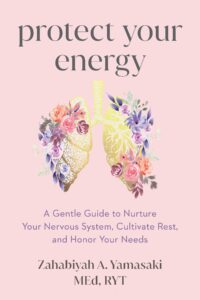
Interested in more? Protect Your Energy is available now!

Zahabiyah (Zabie) Yamasaki, MEd, RYT, is an award-winning trauma-informed educator, yoga trainer, and sought-after consultant and speaker, as well as the founder of Transcending Trauma through Yoga. Her work has been featured on CNN, NBC, and more. Her yoga as healing program is implemented at several universities including the University of California (UC) system, USC, Stanford, Yale, University of Notre Dame, and Johns Hopkins University. She is the author of Trauma-Informed Yoga for Survivors of Sexual Assault, Trauma-Informed Yoga Affirmation Card Deck and flip chart, and two children’s books.