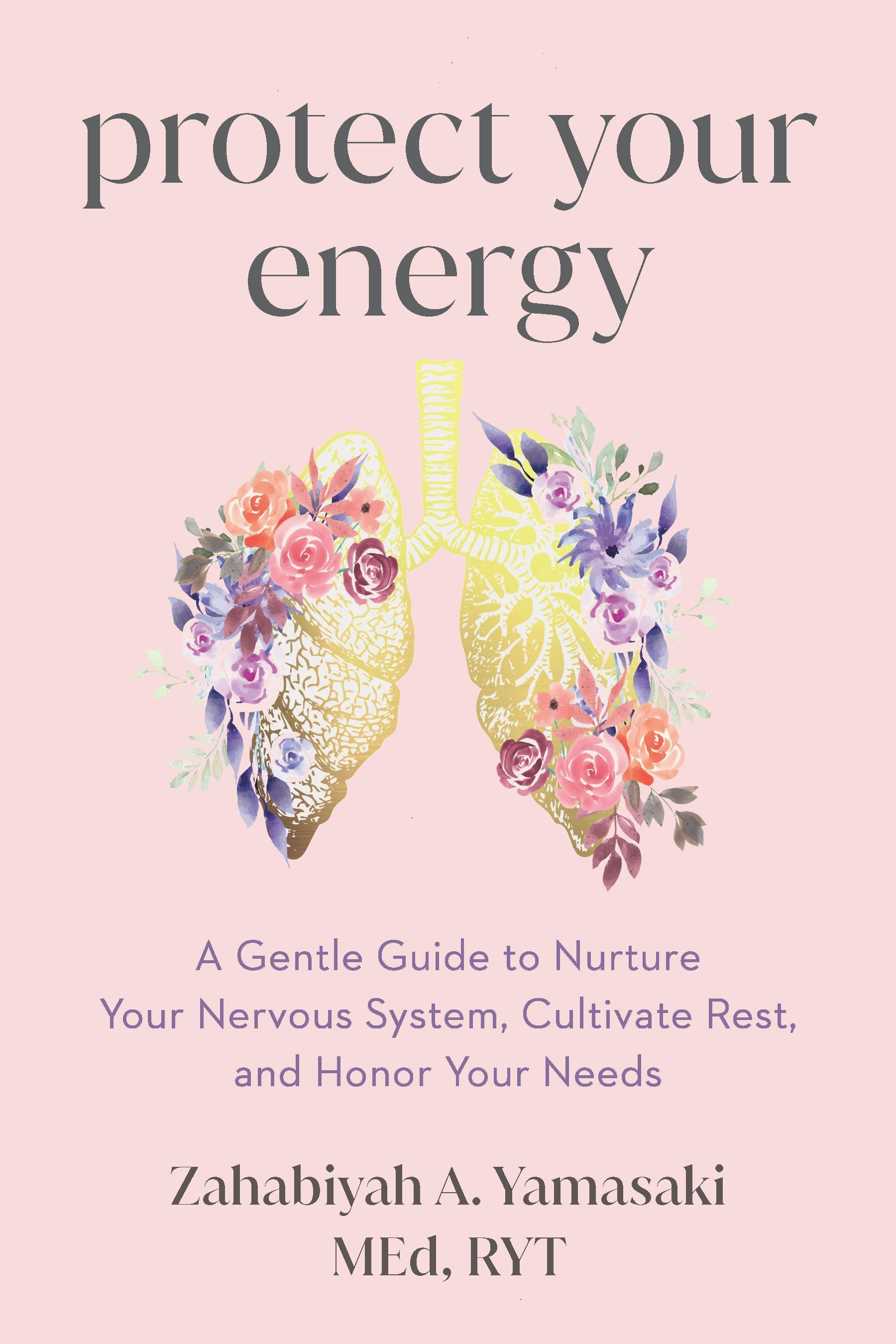
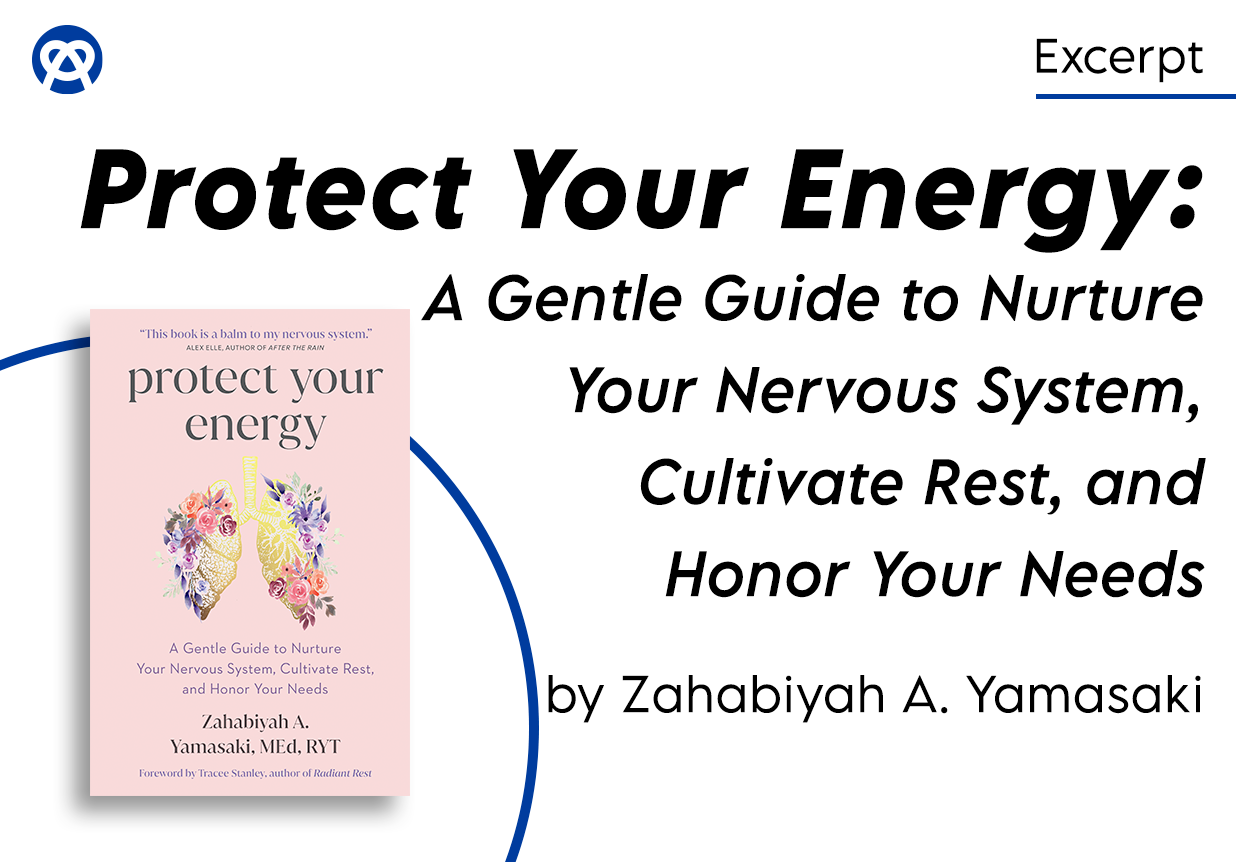
We live in a world of more―work more, earn more, do more. Make vital shifts in how you use your energy―and how you rest―by understanding your nervous system through gentle guidance and practices. Protect Your Energy by Zahabiyah (Zabie) A. Yamasaki offers reflections to help us understand both where we are and where we want to go, what drains our energy, how to set and hold supportive boundaries, and much more. Read a short excerpt or listen to an audiobook excerpt from Protect Your Energy below!
Cultivating a Nurturing Relationship with Your Nervous System
I’ve found that, so often, what prevents us from identifying ways life could feel even a little more manageable is the feeling of overwhelm. Without space for stillness, decompression, and integration, it can feel hard to access the answers we might be yearning for. One of the most affirming statements that I carry with me is one I saw on Instagram from body-positive speaker, feminist, and bestselling author Megan Jayne Crabbe that said, “You don’t have to do the whole thing for it to count.” This can apply to so many facets of life. Showing up for ourselves and getting started is often the hardest part. Honoring the fact that growth can feel painstakingly slow at times is challenging. Patience is healing. Once you begin the journey, the possibilities for reconceptualizing the space you take up in your life are endless. May we never underestimate the cumulative impact of the seemingly small ways we can begin to chip away at all that ails us.
Navigating multiple experiences of trauma and working in a trauma-informed field for over sixteen years has taught me a lot about my relationship to my own nervous system. I learned in many ways that my perfectionist tendencies to overwork, prepare tediously and relentlessly for countless work projects, and view everything through the lens of urgency were trauma responses that deserved healing. My relationship with my nervous system has ebbed and flowed and evolved in myriad and nonlinear ways, just as my healing journey has. The practice of tuning in to my nervous system, and listening to and honoring its messages, has helped buffer the more intense moments of my life. This was not a cure for grief or trauma, but it helped soften the edges and allow me to approach challenges and overwhelm from a place of fullness rather than depletion.
Cultivating a resilient nervous system allows us to process our stress, recalibrate, and flow more easily with life’s daily stressors, so we don’t get stuck in a sympathetic (fight-or-flight) state. This allows us to function and show up in our daily lives, be present, and move flexibly between our various nervous system states. As I began to chip away at the cumulative toll of stress and trauma that was living in my bones for years, the most compassionate practice I could offer myself was gentleness and grace.
Thanks to neuroplasticity (the rewiring of neural pathways), the practice became ingrained in my system over time and offered me space to navigate the storms that at times felt endless. I began to instinctively honor and tend to the most vulnerable parts of myself with an abundance of love and compassion. This in turn started to inform the way I spoke to myself when challenges or crises would arise. I eventually internalized that I was worthy of feeling the presence of peace in my life. Even saying that out loud brings all the emotions to the surface.
Take a moment here to reflect on your relationship with peace: how it shows up, what it feels like, how you cultivate it, and how you protect it. When I think about what peace feels like in my life, some of the first words that come to mind are spaciousness, ease, strong boundaries, and intentionality. A big part of cultivating more peace has been viewing asking for help as a form of strength and remembering the temporary nature of what I might be navigating in a particularly challenging season of life. Sometimes it helps me to do a guided meditation and visualize what my facial expressions look like when I feel at peace, what my environment looks like, and what I notice somatically in my nervous system (softness and lightness). I find it helpful to envision a warm light surrounding me and absorbing any barriers to my pathway to peace. My visions of peace don’t have to be perfect, but giving myself the space to daydream about it makes it feel so much more tangible and attainable.
Lately I have been thinking about nervous system capacity, its intersection with preventative self-care (the ways we tend to ourselves before a busy time), and the amount of space I create for myself each day. Years of survival mode have programmed me to always wait for the next shoe to drop. The next crisis to arise. The next life event that would completely deflate me. Having my armor up all of the time in this way was exhausting, but it was part of how I kept myself “safe.” It took time for me to cultivate another way of being.
A big part of nurturing flexibility in my nervous system is intentionally doing less, saying no, and taking things off of my plate. Sometimes the hardest practice is actually learning how to do less and gently breaking patterns of overworking or numbing myself to avoid facing hard things. It takes courage to allow ourselves to feel deeply. It has taken self-compassion and intention to make this a daily preventative care practice in my life so I can avoid the aftermath of putting out fires in busy and trying seasons. Can you relate to this? Does doing less feel unrealistic to you?
The result of doing this energy-protection work is that it has allowed me to build resilience, so when those inevitable storms of life come along, I have more space to tend to them with groundedness and fluidity. The beauty of honoring the spectrum of our nervous system is that it helps prepare us to navigate the constant ebbs and flows of life. When we can remind ourselves often that nervous system regulation is about nurturing flexibility and resilience between our various physiological states instead of put-ting pressure on ourselves to be calm all the time, it can create noticeable shifts in our healing journey. How powerful of us to honor—without shame or stigma—all the ways our precious body communicates with us.
Just so we are clear, I do not have all the answers, and I still struggle to find my footing sometimes. One of the most self-affirming things we can do daily is to begin again with compassion and softness, which in my opinion is one of the most powerful forms of strength. How human of all of us to acknowledge just how challenging it is to pour into ourselves. And how brave of us to begin to carve out space to reclaim the in-between moments of our lives.
By cultivating an intentional relationship with your nervous system, you can reclaim control of the thousands of ways your energy is depleted each day. You may already be listening and attuning to the messages your body communicates to you in everyday moments: when you have an uncomfortable conversation and notice your face feels hot; when you feel joy and spaciousness and your whole system relaxes; when you spend time with someone you love and their presence makes you feel safe and at ease; when a stressful situation arises at work and you suddenly feel an overwhelming sense of urgency and a desire for control.
Continuing to cultivate this somatic attunement is how you begin to be in relationship with your energy and feel compelled to protect it. When you understand what activates your parasympathetic nervous system (the part of the nervous system that slows the heart and relaxes your muscles) and center this as an everyday practice, you can more intentionally navigate each day in a way that’s more easeful, restful, and sustainable. It is truly a beautiful and life-giving practice. The mind and body practitioners Jennifer Mann and Karden Rabin share “the goal in nervous system regulation is to rewire survival responses and maladaptive coping mechanisms and heal unresolved trauma pathways that have become our default states over time.” This rewiring helps decrease the toll that stress takes on the body.
So, here’s to honoring our humanity and our changing capacity in the many seasons of life to come. This journey is about continuing to show up for yourself and remembering that you are worthy of giving your best versus your all. You deserve to have overflow and reserves for yourself and your loved ones. As the brain coach Jim Kwik reminds us, “On the days you only have 40 percent and you give 40 percent, you gave 100 percent.”
You are worthy of honoring your changing capacity.
You are worthy of honoring your changing capacity.
You are worthy of honoring your changing capacity.
You are worthy of honoring your changing capacity.
Copyright © 2026 by Zahabiyah A. Yamasaki

Zahabiyah (Zabie) Yamasaki, MEd, RYT, is an award-winning trauma-informed educator, yoga trainer, and sought-after consultant and speaker, as well as the founder of Transcending Trauma through Yoga. Her work has been featured on CNN, NBC, and more. Her yoga as healing program is implemented at several universities including the University of California (UC) system, USC, Stanford, Yale, University of Notre Dame, and Johns Hopkins University. She is the author of Trauma-Informed Yoga for Survivors of Sexual Assault, Trauma-Informed Yoga Affirmation Card Deck and flip chart, and two children’s books.