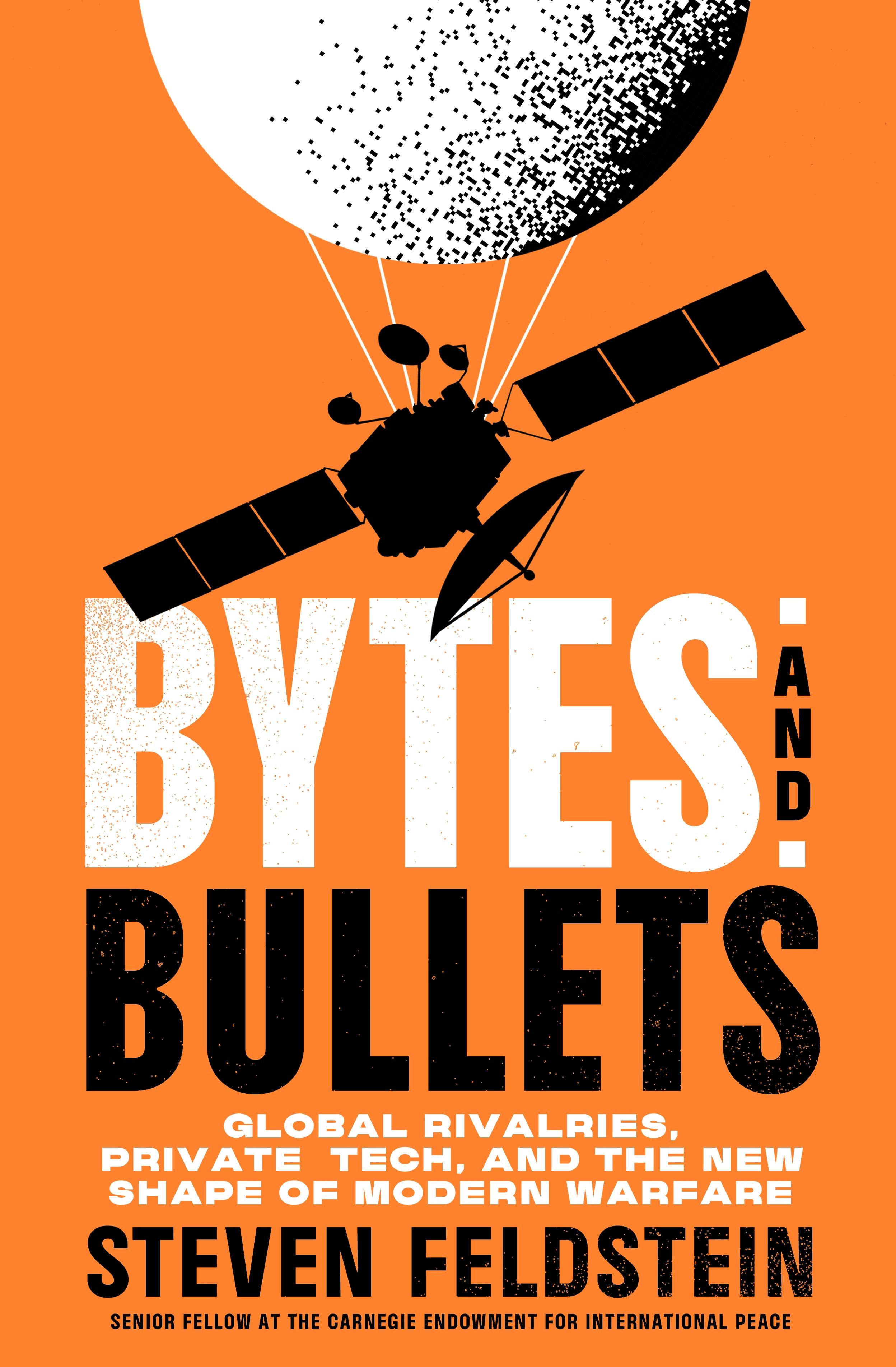
For decades, the US set the international rules on innovation, standards, and export regulations, using soft power and federal funding to both develop cutting edge tech and prevent its rivals from acquiring it. But in the digital era, major breakthroughs in everything from AI systems to autonomous drones now come from private companies, not government labs. Bytes and Bullets is an analytically rich account of how technology is upending global competition. Through engaging stories and original research, Carnegie Endowment senior fellow Steve Feldstein explains how America’s primacy is being undercut at every turn by commercialization, China’s growing capabilities, and new regional powers building their own spheres of influence. Read an excerpt from Bytes and Bullets below.
Changing Balance of Power
The balance of power is shifting in the world, but not always in the ways people think. The University of Denver’s Pardee Center created a “global power index” to measure countries’ relative share of power worldwide. Its model uses a weighted combination of military, demographic, economic, technological, and diplomatic factors. From the end of the Cold War through 2022, there was a gradual erosion of American power—in large part due to China gaining ground.
US influence remains high relative to other states. As of 2022, America still controlled nearly a quarter of the global share of power despite having under 5 percent of the world’s population. When the United States’ portion is combined with the European Union’s, their global share of power exceeds 40 percent. In contrast, China continues to lag behind. Other would-be challengers, such as India, Japan, or Russia, barely exceed the 3 percent threshold. But longer trends paint a less optimistic picture; America’s global power has clearly slipped over the decades.
Looking to the future, the signs are muddled. Most experts agree that the foremost geopolitical challenge of the twenty-first century involves managing a rising China seeking to become a dominant power and a de-clining United States trying to preserve its influence. But consensus breaks down from there. One school of thought holds that China will overtake the United States and claim “power predominance” in as little as a decade. Experts argue that only a dramatic shift by Washington can stem China’s rise. Other analysts fall into an “optimist” camp, unconvinced that China will overtake the United States (and even if this transpires, they argue, China will be incentivized to pursue relatively moderate policies). Their biggest worry is that the two countries will enter a destabilizing “spiral of hostility” fueled by high-tech export restrictions and military buildups in East Asia.
Despite forecasters’ best efforts, it is impossible to anticipate how these trends will play out. Even deciphering the present data is difficult. China’s statistics are deliberately obscure and its officials often release misleading data or “present only facets of the reality they want the world to see,” making it hard to know China’s actual power and status, let alone what they will look like in ten or fifteen years’ time. The best we can hope for, then, is to obtain a deeper understanding of underlying trends that will shape future policies in the United States and China. On this basis, three insights are relevant about America’s role in the world.
First, while China’s rise will undoubtedly continue and its material share of global power could surpass the United States in the next decade, this doesn’t mean that China will supplant the United States as a superpower. China will encounter bumps along the road. Hal Brands, for example, argues that the drivers of China’s growth are already stagnating or in decline. From the 1970s to the 2000s, China possessed abundant food, water, and energy resources. It enjoyed “the greatest demographic dividend in his-tory,” with ten working-age adults for every senior citizen. Those factors led China to become the global center of manufacturing and allowed the nation to cut poverty at a stunning rate. Now, the situation has reversed. China is running out of water and is a net importer of energy and food, making economic growth more costly and fostering an unhealthy reliance on external trade. Its declining demographic picture also raises alarm bells—China is losing population at a rapid clip. Thanks to its one-child policy, which was implemented in 1980 to curb overpopulation and ended in 2016, China’s population fell by 2.08 million, with new births dropping by 6 percent in 2023 alone. A new trend is taking hold: outward migration. More than three hundred thousand Chinese annually are leaving for other countries, twice as many as a decade ago.
Looking at China’s economic productivity also offers insights. Historically, two factors are crucial to determining whether a rising state will over-take an existing great power: the size of the economy and its productivity (roughly calculated as the ratio of a country’s GDP to total hours worked). If a country is economically efficient but has a small economy—such as Norway or Switzerland—then its lack of size renders it noncompetitive. Conversely, if a country possesses a large economy but runs it inefficiently—like India—then this also nullifies its advantages.
China’s economy is large. By some measures, its GDP is equal to that of the United States. In 2022, its GDP stood at $17.96 trillion, close behind America’s GDP of $25.44 trillion; when purchasing-power parity is factored in, China’s economy slightly exceeds the United States’. But Beijing faces a major obstacle: lagging productivity. From 2000 to 2017, China’s total productivity “never surpassed 43 percent of the US,” writes Jeffrey Ding, a scholar at George Washington University. Moreover, China’s future productivity growth is uncertain. Due to inefficient infrastructure outlays, China’s productivity growth declined from 2.8 percent in the early 2000s to 0.7 percent in the decade after (2009–2018). As a result, Beijing faces a major productivity challenge in the years ahead. Unless China can dramatically improve its efficiency from new technologies and manufacturing products, it will struggle to make up ground with the United States.
For the sake of argument, suppose that China somehow found a winning formula that allowed it to dramatically increase its productivity and surpass America’s economic output as well as develop new military technologies. That still wouldn’t make China a military peer of the United States. Developing new weapons and tactics “depends on decades of ex-pensively accumulated technological and tactical experience,” writes MIT scholar Barry Posen. Successful war fighting requires extensive training, experience in combat, and effective force deployment. Military dominance is not something that magically happens once a country’s economy reaches a certain threshold of size or a country’s army attains a specific number of planes or tanks.
Second, it is unlikely that any middle-power state—or group of middle powers—will challenge the United States or China for dominance in the near future. Aside from the EU (which, as a regional grouping of countries, belongs in a slightly different category), the closest state competitor is India. But even by 2050, its expected share of global power will remain low. While India will accrue greater influence due to its large population and emerging industrial base, on its own it will be unable to tilt the global balance of power. However, it would be unwise to underestimate the growing heft of the “hedging middle.” Countries in the Global South will be intent on diversifying their relationships and optimizing their choices. As William Burns warns, they will see little benefit to “sticking to monogamous geopolitical relationships with either the United States or China.” Instead, more countries will seek open-ended relationships with multiple larger powers—perhaps following America’s lead on certain issues while fostering ties with China on other matters.
The growing relevance of the BRICS grouping, of which China is a major anchor, is instructive. The acronym stands for the group’s founding five members: Brazil, Russia, India, China, and South Africa. It has since expanded to include Egypt, Ethiopia, Iran, and the UAE (Saudi Arabia is also a participant, but it is not a formal member). Many in the West predicted the group’s rapid demise when it launched in 2009 but its trajectory has gone in the opposite direction. Its ten current members represent over 35 percent of global GDP in purchasing power parity—the exchange rate at which money buys the same amount of goods and services in different countries—exceeding the G7’s global GDP share of 30 percent. In the coming years, the BRICS will likely expand further, “with more than 40 countries expressing interest in joining.” Its October 2024 summit in Kazan, Russia, was telling. The Kremlin crowed that the meeting was the biggest foreign policy event ever hosted by Russia and represented the “literal embodiment of a revisionist approach to the transformation of the international order.” Attendees lavished praise on one other. Prime Minister Abiy Ahmed of Ethiopia, once the toast of the West (and the ill-advised winner of the Nobel Peace Prize) gushed to Putin, “This period was not easy for Russia, but under your leadership you have succeeded to maintain the economic resilience which might be exemplary for most of us.”
Third, the influence of the West (anchored by the United States and Europe) will continue to wane. America’s diminished ability to “command the commons”—to exert ongoing and continuous superiority over air, sea, and space—will open up space for rival actors. Arguably, Trump’s anti-globalization instincts are speeding up this process. As China catches up to the United States, this will inject more uncertainty into the international system. Already, the long post–Cold War peace guaranteed by American power has ended. If policymakers once expected that major powers would stop treating each other as rivals and would instead compete over economic investment and trade, events in the last decade have refuted these assumptions. Russia is engaged in a protracted hot war against Ukraine. China is arming itself with alacrity and pursing menacing actions in the South China Sea and toward Taiwan. Iran, Israel, and Türkiye have developed sophisticated weapons industries whose proliferation is triggering more instability. Meanwhile, Trump is steering the United States in a more confrontational, unilateral, and illiberal direction.
What does all this add up to? More than anything, these trends mean there will be greater unpredictability in the international system. Within a decade, no country will be a fully dominant power. As leaders contemplate these projections, they must confront an unsettling reality: they are steering their nations into security waters more treacherous than any navigated in recent decades.
Copyright © 2026 by Steve Feldstein

Steve Feldstein is a senior fellow at the Carnegie Endowment for International Peace. An international expert on technology, democracy, and national security, he previously served as a senior official at the State Department and for the Senate Foreign Relations Committee. His first book, The Rise of Digital Repression, won the 2023 Grawemeyer Award for Ideas Improving World Order. He has appeared on CNBC, ABC, CSPAN, NPR, and BBC, and his writing has appeared in The Atlantic, Foreign Affairs, and Lawfare, among others.