Automating Inequality - Pretzl Skip to content
SMP header Area
  • Our Books
  • In the news
  • Articles
    • Excerpts
    • Op-Ed
    • Roundups
  • About Us
Pretzl Header Mobile Area
  • Our Books
  • In the news
  • Articles
    • Excerpts
    • Op-Ed
    • Roundups
  • About Us
Subscribe to our Newsletter
  • Business

Home Our Books Automating Inequality

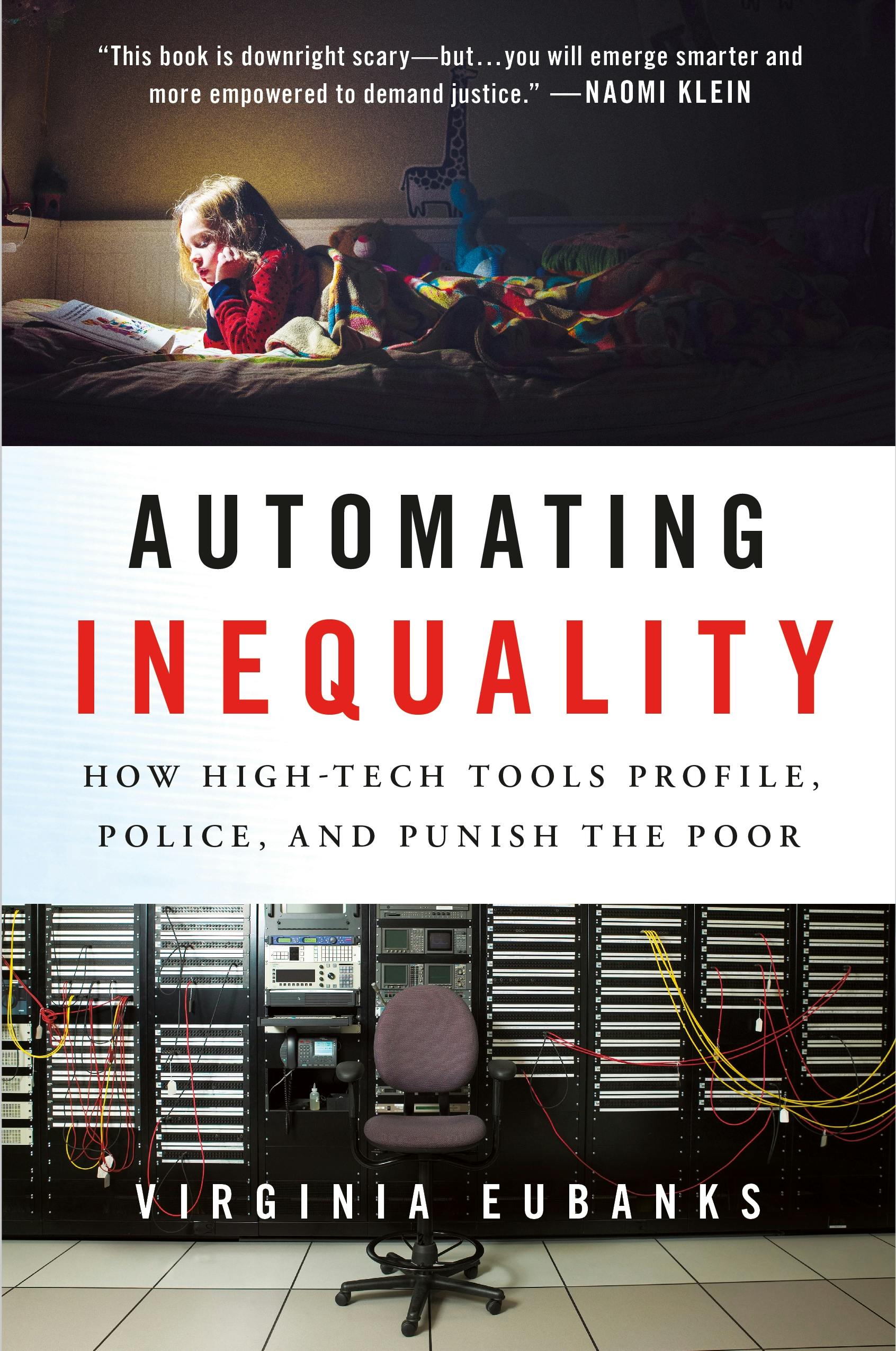
Automating Inequality

Describes for Automating Inequality by authors
Publication Date: January 23, 2018

Automating Inequality

Virginia Eubanks

Present Authors date for  Automating Inequality by authors
Publication Date: January 23, 2018
WINNER: The 2019 Lillian Smith Book Award, 2018 McGannon Center Book Prize, and shortlisted for the Goddard Riverside Stephan Russo Book Prize for Social Justice

Astra Taylor, author of The People's Platform: "The single most important book about technology you will read this year."

Dorothy Roberts, author of Killing the Black Body: "A must-read."


A powerful investigative look at data-based discrimination?and how technology affects civil and human rights and economic equity

The State of Indiana denies one million applications for healthcare, foodstamps and cash benefits in three years—because a new computer system interprets any mistake as “failure to cooperate.” In Los Angeles, an algorithm calculates the comparative vulnerability of tens of thousands of homeless people in order to prioritize them for an inadequate pool of housing resources. In Pittsburgh, a child welfare agency uses a statistical model to try to predict which children might be future victims of abuse or neglect.

Since the dawn of the digital age, decision-making in finance, employment, politics, health and human services has undergone revolutionary change. Today, automated systems—rather than humans—control which neighborhoods get policed, which families attain needed resources, and who is investigated for fraud. While we all live under this new regime of data, the most invasive and punitive systems are aimed at the poor.

In Automating Inequality, Virginia Eubanks systematically investigates the impacts of data mining, policy algorithms, and predictive risk models on poor and working-class people in America. The book is full of heart-wrenching and eye-opening stories, from a woman in Indiana whose benefits are literally cut off as she lays dying to a family in Pennsylvania in daily fear of losing their daughter because they fit a certain statistical profile.

The U.S. has always used its most cutting-edge science and technology to contain, investigate, discipline and punish the destitute. Like the county poorhouse and scientific charity before them, digital tracking and automated decision-making hide poverty from the middle-class public and give the nation the ethical distance it needs to make inhumane choices: which families get food and which starve, who has housing and who remains homeless, and which families are broken up by the state. In the process, they weaken democracy and betray our most cherished national values.

This deeply researched and passionate book could not be more timely.
Amazon links for SMP Presentation for Amazon IndiaAmazon Barnes Noble links for SMP Presentation for Barnes NobleBarnes & Noble Presentation for BAMBooks-a-Milion Bookshop links for SMP Presentation for BookshopBookshop Apple links for SMP Presentation for AppleTarget Walmart links for SMP Presentation for WalmartWalmart
WINNER: The 2019 Lillian Smith Book Award, 2018 McGannon Center Book Prize, and shortlisted for the Goddard Riverside Stephan Russo Book Prize for Social Justice

Astra Taylor, author of The People's Platform: "The single most important book about technology you will read this year."

Dorothy Roberts, author of Killing the Black Body: "A must-read."


A powerful investigative look at data-based discrimination?and how technology affects civil and human rights and economic equity

The State of Indiana denies one million applications for healthcare, foodstamps and cash benefits in three years—because a new computer system interprets any mistake as “failure to cooperate.” In Los Angeles, an algorithm calculates the comparative vulnerability of tens of thousands of homeless people in order to prioritize them for an inadequate pool of housing resources. In Pittsburgh, a child welfare agency uses a statistical model to try to predict which children might be future victims of abuse or neglect.

Since the dawn of the digital age, decision-making in finance, employment, politics, health and human services has undergone revolutionary change. Today, automated systems—rather than humans—control which neighborhoods get policed, which families attain needed resources, and who is investigated for fraud. While we all live under this new regime of data, the most invasive and punitive systems are aimed at the poor.

In Automating Inequality, Virginia Eubanks systematically investigates the impacts of data mining, policy algorithms, and predictive risk models on poor and working-class people in America. The book is full of heart-wrenching and eye-opening stories, from a woman in Indiana whose benefits are literally cut off as she lays dying to a family in Pennsylvania in daily fear of losing their daughter because they fit a certain statistical profile.

The U.S. has always used its most cutting-edge science and technology to contain, investigate, discipline and punish the destitute. Like the county poorhouse and scientific charity before them, digital tracking and automated decision-making hide poverty from the middle-class public and give the nation the ethical distance it needs to make inhumane choices: which families get food and which starve, who has housing and who remains homeless, and which families are broken up by the state. In the process, they weaken democracy and betray our most cherished national values.

This deeply researched and passionate book could not be more timely.

ABOUT THE AUTHOR

This is author Virginia Eubanks for books
Pic Credited (William Gill)
Virginia Eubanks is a professor and an investigative journalist whose work has appeared in The New York Times Magazine, Harper’s Magazine, The Guardian, Nature, and Scientific American. She is the author of the award-winning book Automating Inequality: How High-Tech Tools Profile, Police, and Punish the Poor. When not sleeping in her truck in the Adirondacks, she lives in Troy, New York.
Author for facebook Virginia EubanksAuthor for twitter Virginia EubanksAuthor for GoodReads Virginia Eubanks Author for Instagram Virginia Eubanks

Related Books

By books Big Weed related books
Big Weed

Joseph D’Agnese

LEARN MORE
By books Loonshots related books
Loonshots

Safi Bahcall

LEARN MORE
By books Surrounded by Idiots related books
Surrounded by Idiots

Thomas Erikson

LEARN MORE
By books The Power of Agency related books
The Power of Agency

Anthony Rao

LEARN MORE
SMP Footer Showing Content

Our mission is simple: Help you achieve your goals—whether you’re a CEO, just starting your career, or simply searching for a little guidance in life. Presented by St. Martin’s Publishing Group, Pretzl has a carefully curated collection of cutting-edge books and articles with informative, accessible insights from thought leaders across a wide range of interests and expertise.

Facebook-f Twitter Instagram Pinterest

explore

  • Our Books
  • In the News
  • Articles
 
  • About Us
  • Privacy Notice
  • Your Privacy Choices
  • Terms of Use

Subscribe to our newsletter

Enter your Email and receive the Latest Updates

Copyright © 2026 Pretzl. All Rights Reserved.