I was waiting at a bus stop near Times Square, on my way home from the theater, when I noticed a dapper-looking man standing a few feet away, craning his neck to search the oncoming traffic.
“Are you waiting for the 104 bus, by any chance?” I offered. “If you are, my app says it’s coming in six minutes.” The man said he was and thanked me. I noticed he had a program in his hand, so I asked him what show he had gone to see.
What followed was one of the most interesting conversations I have ever had with a stranger. After exchanging opinions about the shows each of us had attended that night, we continued to chat for the whole forty-block bus ride. It turned out that this man, now in his eighties, had been a professional singer/dancer his whole life and had performed on Broadway in all my favorite musicals–from Oklahoma in 1969 to The Producers in 2006. This man’s stories were actually more entertaining than the play I had just seen.
Never mind what your parents told you about talking to strangers. The truth is that it’s a practice that is both important and potentially rewarding. In fact, talking to strangers is one of the reasons I moved to New York City. Because most New Yorkers are on foot or on public transit instead of in cars, they tend to talk to each other more than people who live in car-centric locations do. Unfortunately, smart phones have had a dampening effect on this phenomenon; these days it often takes a little more effort to get someone’s attention. But it’s usually worth it.
Most of us don’t realize just how much the practice of talking to strangers can enhance our lives. We leave our houses encased in our own self-involved bubbles, often seeing the strangers around us as just part of the scenery. The idea of striking up a conversation with the person standing next to us in a line or sitting next to us on a bench can seem weird–potentially awkward, a waste of time, or even dangerous. What if the person is unpleasant, or unbalanced? we think. Or even worse–what if they think I am hitting on them?) But as radical as it may seem, I encourage people to interact with strangers whenever possible.
For one thing, countless studies have shown that the more face-to-face connecting you do, the better it is for your mental and physical health. And every in-person conversation–even with someone you don’t know–adds to the fabric of your life experience. Even a twenty second exchange can sprinkle a little spice on your day. Talking to strangers can also be liberating. After all, strangers don’t know you, so talking to them can free you in a way. You can alter your normal conversational personality if you want–try out a new mood, or an uncharacteristic witticism.
Maybe most important, talking to strangers is an exercise in mindfulness. Most of us are rushing through our days, constantly thinking about where we are going and what we are going to do or say when we get there. But there are no goals in these spur-of-the-moment conversations. Your spontaneous exchange with someone in the grocery store is not about creating friendships, or furthering your position in life (though these things may occasionally happen) but rather about being totally present in an individual moment, engaging with what is right in front of you.
So what are the best places for talking to strangers? Besides the obvious venues like parties, bars, restaurants and cafes, it feels very organic to speak to strangers at parks, the beach, or festivals–any place where people are relaxing. In recreational situations people usually have the same attitude as when they are traveling; they tend to want to share the fun with those around them.
Basically, it is easiest to talk to strangers anywhere you are having a common experience, especially while you are waiting. Whether it’s an interminably long ladies room line or a jury duty assembly room, the communal boredom, frustration or confusion about why things are taking so long inspires obvious conversation starters. Bus stops and train stations are also good for interacting with your fellow humans. (Airports are trickier, because of the amount of time is spent there and how stressed most people are.) Stores and farmer’s markets are fertile “mingling” arenas. I even encourage people to chat briefly to strangers in elevators, though this may seem extreme to some people.
Once you get into the habit of conversing with strangers, you won’t have to think too much about what to say. Making an observation about the weather or your surroundings is a natural thing to do. (For example, “It always rains when I forget my umbrella!” Or “I can’t believe how crowded it is in here.”) Asking for information or offering help is also a good opening. (“Excuse me, have you ever tried this type of cheese?” Or “I see you’re looking at the map. Can I help you?”)
Of course, there is always some risk involved. Not everyone is open to speaking to a stranger (though you’ll be surprised how many people are) so you might be ignored or rebuffed. On the other hand, you may be the one to immediately realize, after your initial overture, that you do not want to have a conversation with this person. Never fear; your cell phone provides a facile retreat. Just turn or move slightly away as if you have to focus on the text you just got–or even fake a call, if you must.
Occasionally you may find you are simply not in any frame of mind to interact with anyone. You’ve had a terrible day at work, you feel overwhelmed and overstimulated and you just want to put in your air pods and listen to your favorite podcast. But do keep in mind that the digital world is an addictive drug that tends to isolate us, and consider what you might be missing. Every time you venture to talk to someone you come across in your day-to-day routine, it’s like unwrapping a surprise gift. You never know what could be inside.
Needless to say, most stranger interactions will be much more mundane than the conversation I had with the Broadway theater veteran. But trust me, they can still feed your soul.
The other day I was out walking in my neighborhood when it started to drizzle. Everyone started hurrying along the sidewalk, trying to beat the rain. This proved difficult, as on this particular block there was a lot of building construction, as well as a large, slow-rolling Amazon cart blocking pedestrians’ paths. Suddenly a man shot out from behind me, attempting to thread his way into the gap between a ladder leaning up against the wall and the moving Amazon cart. The space narrowed before he could reach it and he gave up.
“Lot of obstacles out here today!” I called out to him sympathetically.
The man turned around, grinning broadly at me. “That’s for sure!”
It was only a moment’s connection, but it brightened the rainy day, just a little.
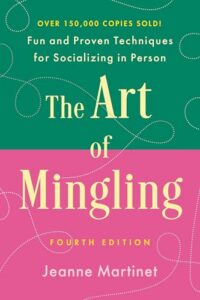
Interested in more? The Art of Mingling, Fourth Edition is available now!

Jeanne Martinet is the author of nine books, including The Art of Mingling which has sold more than 150,000 copies and been published in ten countries. She has been featured in such publications as The New York Times, Newsweek, Cosmopolitan, Glamour, and The Washington Post. She has shared her humor and mingling know-how on hundreds of podcasts, TV and radio shows, including “The Today Show,” “The CBS Early Show,” and NPR’s “Morning Edition.” She has been a keynote speaker and has given workshops on the subjects of mingling and networking. Born and raised in Baltimore, she lives, writes and mingles in Manhattan.