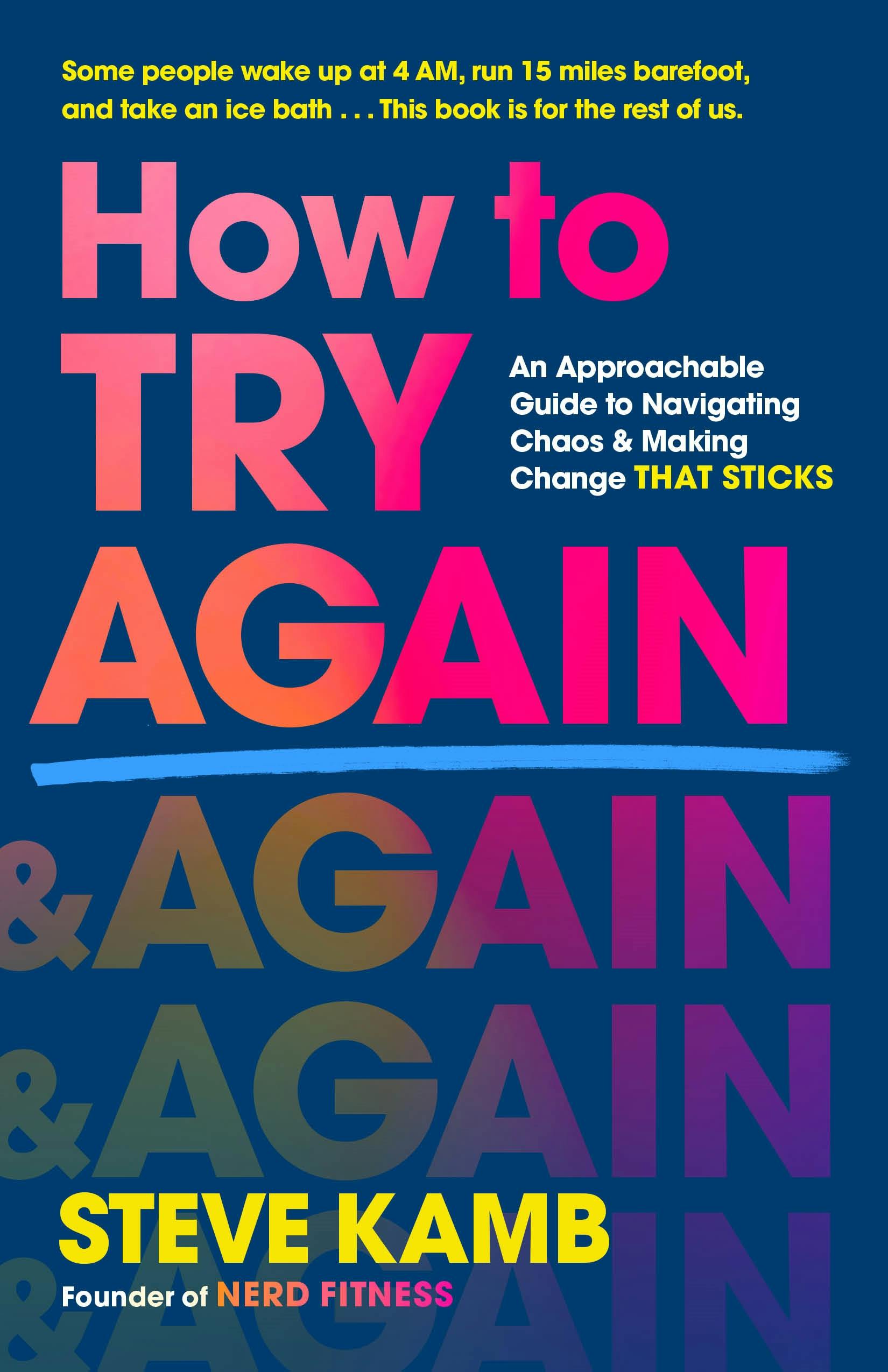
Steve Kamb, founder of Nerd Fitness, has helped tens of millions make sustainable progress, even when life happens. In How to Try Again, he presents a guide to help readers transform their lives by giving up more often, failing faster, and mastering the art of starting over. The false promises of optimized wellness and productivity are a recipe for personal blame and frustration. Fortunately, escaping this doom loop is Steve Kamb’s superpower. Read an excerpt from How to Try Again below.
Failure Is One Possible Outcome of Anything Worth Doing
In 2023, I took a trip to the Museum of Failure, a touring museum created by psychologist Dr. Samuel West.
It was packed full of history’s most famous failures, flops, and frauds. Proudly on display was the Hula Chair: a swiveling seat designed to allegedly help people shed stubborn belly fat by doing a sitting “hula dance.” Instead, it tosses the victim’s body and torso around like a medieval torture device.
Would not recommend.
There was a model of the Swedish king Gustav II’s comically expensive military warship. After years of delays and dozens of nonsensical alterations, it sank to the bottom of the harbor fifty minutes into its celebratory voyage. Talk about a sunk cost. (Don’t worry, the bad jokes in this book are going to get much worse.)
The museum also featured a model plane and the absurd tale of Hooters Air. Yes, that Hooters. If you ever feel like a failure for not making smarter decisions, just imagine how many people had to agree with the following sentence: “We got rich making chicken wings; how hard could it be to run a profitable airline?”
I assume Hooters Seminary School and Hooters Brain Surgery Academy were the next two ideas on the list.
Now, alongside these obvious disasters, I found failed products from some of the world’s most successful companies. My beloved Nintendo had quite a few on display: Even my mom and dad knew not to buy me the Nintendo Virtual Boy, a 1995 headset that could cause eye strain for some children and was discontinued by 1996. Oops!
Microsoft was well represented too, most notably with their ill-fated Zune MP3 player. It was supposed to take down the iPod and instead ended up forgotten.
Even Apple, one of the most successful companies in history, had a video game console on display called the Pippin. This console was so unsuccessful that even I, a proud nerd gamer, had never heard of it.
In addition to the clear failures and terrible ideas, there were many featured products that were casualties of poor timing: early chatbots, multifunctional cell phones, personal digital assistants, and the first digital camera, invented in the mid-1970s. It was such a breakthrough that Kodak never released it for fear of cannibalizing their sales of physical film! (We know how that worked out for them in the long term: They filed for bankruptcy in 2012.)
For so many of these failures, they were just too early. The vision was there, and once technology finally caught up to the ambition, the road had been paved for companies to have far grander and more important successes down the road.
The more failures I saw, the more I came to understand failure differently. This museum didn’t only exist to poke fun at bad inventions. I mean sure, it did that too. I’m still laughing about Hooters Air. But it also showed the ways in which failure was simply the cost of doing business. Spending the afternoon in the museum reshaped how I thought about setbacks, risk, and the opportunity cost of living in fear of failure.
Failure isn’t a flaw that must be prevented from happening. So many rewards in life are only available to those willing to open themselves up to failure as a possibility.
Dr. Theresa MacPhail (yes, she has the perfect last name), an associate professor of science and technology studies at Stevens University, observed that many overachieving college students struggle to handle their first academic failures. She knew this wouldn’t be the last adversity they’d face in their lives, so she decided to do something about it. In addition to her classes, she took a chance and offered to teach a class on embracing and reframing failure. In the greatest of ironies, her class has become so successful that seven years later, it has a long waitlist every semester.
And until we can sneak into Dr. MacPhail’s class, let’s see what lessons failure can teach us. Here are the most important.
Failure is one possible outcome for anything worth doing.
Ed Catmull, one of the founders of the animation studio Pixar, said it best in the book Creativity, Inc.: “Failure isn’t a necessary evil. In fact, it isn’t evil at all. It is a necessary consequence of doing something new.”
It’s why Pixar encourages their teams to embrace these counterintuitive strategies:
It’s not a manager’s responsibility to avoid risks, but to make it safe for the team to take more risks.
The cost of preventing mistakes is often far greater than the cost of fixing them.
The job isn’t to protect against change or uncertainty, but to develop the ability to recover after unexpected events occur.
If failure is one possible outcome, then adding extra pressure and shame on top of failure isn’t serving us. It’s not something to be avoided nor something to be ashamed of.
Copyright © 2026 by Steve Kamb

Steve Kamb is the author of How to Try Again and founder of NerdFitness.com, an approachable fitness company that helps busy humans level up their lives. Since 2009, Steve has published research-backed essays and a weekly newsletter that explores failure, self-compassion, and making change that sticks, especially when life doesn’t go according to plan. He lives in Nashville, TN, where he plays golf decently and music poorly.
Photo Credit: Mackenzie LaRoe