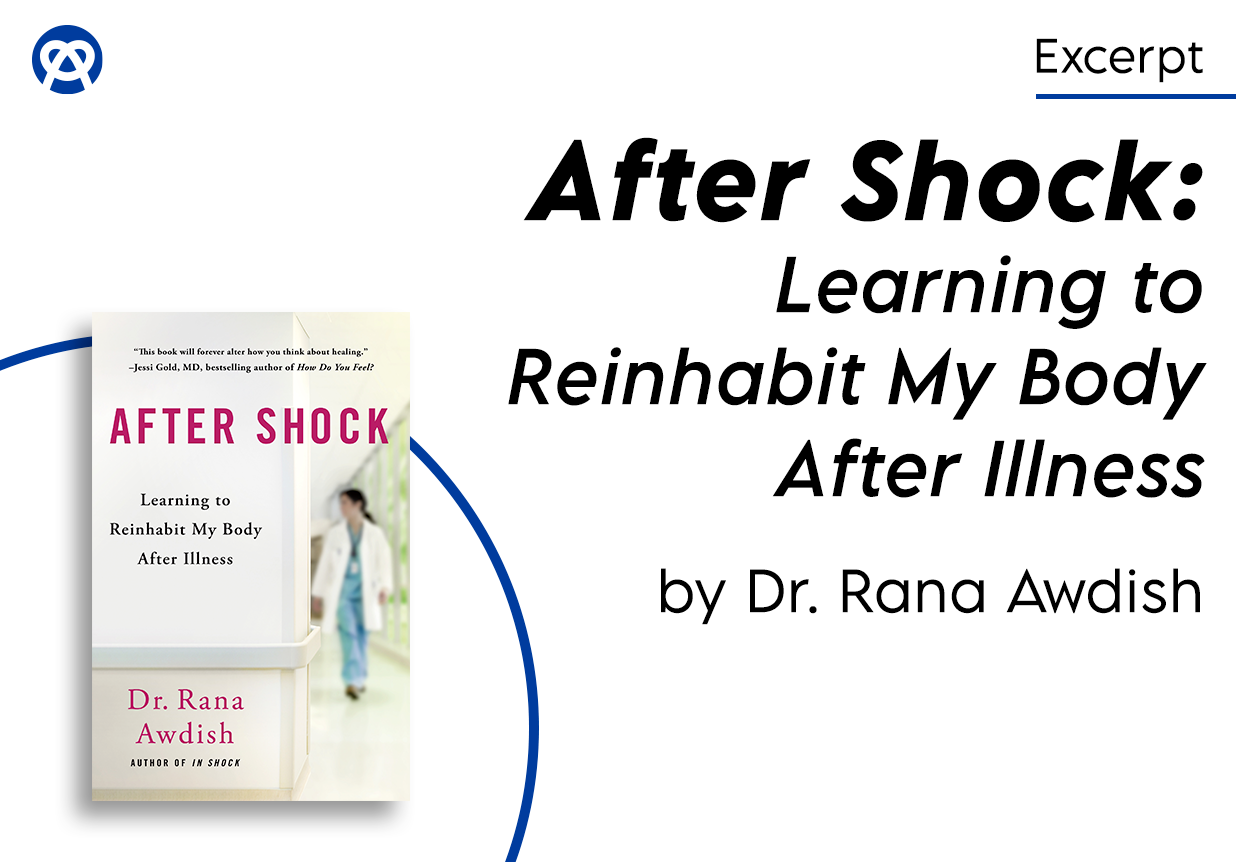
In the aftermath of her own critical illness, physician and writer Dr. Rana Awdish finds herself oddly estranged from her own body. Medicine has conditioned her to view sick bodies as broken objects, not as sites of meaning, mystery, and quiet wisdom. So, when her own body warns her that she’ll be dead in five years, she’s unsure whether to trust it enough to follow where it leads. Allowing for this kind of innate, bodily wisdom would require her to dismantle and reconfigure her entire belief system. She decides to take a leap of faith, abandon certainty and surrender to the message—a choice that ultimately saves her life. What emerges is a profound and vulnerable meditation on the true nature of healing. Read an excerpt from Dr. Rana Awdish’s new book, After Shock, below.
Then Randy stood and stared at me for what felt like an uncomfortable amount of time. He was looking at me with a deep seriousness, mouth slightly open and with a tension in his forehead. It was either an expression of concern or deep concentration, and either way, it did not track with the situation. I lifted my arms and curved forward to look down at my abdomen, worried that the bath had somehow disrupted an old scar and that I might be oozing blood through my shirt. I wasn’t. I couldn’t imagine why he was looking at me so strangely.
Finally, he asked me something so ridiculous that it made my irrational fear of late scar dehiscence by bath seem logical by comparison.
“What if, and I want you to hear me out on this, we get you a really cute tricycle?” he asked.
“A tricycle? You can’t be serious,” I said. If I didn’t know him, and if the look on his face hadn’t been so solemn, I might have thought he was making fun of me.
“Well, if you want to go on bike rides with us, and you want to recondition your body, and it’s just the balance issue that’s keeping you away, why not get a tricycle?”
Why not get a tricycle? He was presenting it as if it were a straightforward solution. It was logical and possibly even helpful. It could be perceived as just slightly strange, but it was also weirdly practical. I was having a hard time considering it as an option, and I was not entirely sure why, beyond the obvious issue of it being a TRICYCLE.
Why not get a tricycle? Because I had been socialized to fit myself into the spaces the world left available, and not to expect accommodation.
Why not get a tricycle? By the third time the question echoed in my mind, it occurred to me that perhaps I was the problem— but not in the way I thought. My struggle to imagine a bike- based solution stemmed from seeing the issue as rooted in my body, never considering whether my environment could adapt. Medicine had always placed the blame on bodies. My training had omitted perspectives that reframed disability as a mismatch between bodies and environments. By internalizing the medical model, I lacked a framework that might allow me to envision alternatives.
Where I could only see what I couldn’t do, in Randy’s eyes I was not broken; I was simply challenged by a situation. He believed that the essential problem was one of bike design, and that the solution just required finding a stable version of a bike that could accommodate me. It was a more social model of disability, one he may have encountered while studying the law surrounding inaccessible public spaces. Regardless of how he arrived at this framing, it was clear, he didn’t view my balance issue as a personal failing. This freed him to see it as simply a barrier to me doing things I wanted to do. This externalization redistributed the blame, and a tricycle became a strangely obvious solution.
I felt a rising sensation in my body. Something that felt like compassion. Through this lens, more options became available. I was both whole and in need of help.
Incredibly, I had never once thought of a sick body in that way.
* * * * *
Of course, I didn’t tell him any of that. What I said instead was, “An adult tricycle? Is that even a thing?” I genuinely didn’t know, but I was also stalling.
“Sure it is. I bet we could find a cute one, with a basket even,” he said.
He knew me well enough to know that the aesthetics of the thing mattered. He knew that if the bike was attractive enough, I would be more likely to engage in what might prove to be a challenging physical activity for me.
The bike he ultimately found was in fact beautiful. It was a seafoam-green Schwinn, with a folding rear basket and three large, sturdy wheels. It looked as if the manufacturers designed it to exclusively be used for trips to farmers markets and summer picnics. It was cute enough to merit its own Instagram handle, though I resisted the temptation. It was also undeniably stable. Once it was assembled and the tires were all inflated, he pressed on it dramatically from every angle, showing me that not only did nothing snap, but it also could not be toppled.
He strapped an old-fashioned horn onto the right handlebar and told me, “This is so you can signal us if we need to slow down. You know Walt likes to go fast sometimes, even after his accident, so I’m hoping this will rein him in a bit and allow you to keep up.”
After admiring the cheery charm of it, I climbed onto the brown leather seat for the first time, placed my hands on the handlebars, set my feet on the pedals, and just sat in place.
Randy saw me not moving and twisted his mouth to the side, seemingly uncertain as to whether this was going to constitute a success or not. He looked around, presumably searching for other barriers that he hadn’t accounted for and that might need to be dealt with prior to me riding it.
“Do you want me to pull it down to the bottom of the driveway, so you don’t have to start on an incline?” he asked. “Is it making you dizzy to look down?”
“No, I want you to take a picture, actually,” I said, taking my phone out of my back pocket and handing it to him. He took my phone, looking confused, and took a series of pictures before handing my phone back to me.
I sat on the tricycle, staring at the picture of me sitting on the tricycle. I was wearing jeans, muddy boots, a short- sleeved ivory shirt, and sunglasses. The sun was behind me, and I was smiling. I saw myself differently, even before I pedaled a single revolution of a single wheel. Even before I rode it out of the driveway.
“I love it. Thank you,” I said.
“Now that you are safe, you are going to love bike riding, for real,” Walt said, with great confidence.
The tricycle was comically heavy, and it couldn’t go very fast, but it showed me that my body could take me places. The back wheels were nearly too wide to fit on the sidewalk. The collapsible wire basket jostled and clinked loudly with each bump, and I had to pack it with picnic blankets to muffle it. For the neighborhood children who were just learning to ride a bike, seeing me, an adult on a very large tricycle, provided some added comic motivation.
“I guess she just never learned to ride a big-girl bike,” I heard one of them say to his brother as I passed them.
“How sad for her,” his brother said.
“Don’t give up! We believe in you!” he yelled after me.
Riding it didn’t bring the exhilaration of childhood, the delirious freedom of coasting downhill at high speeds. It couldn’t match the innocent bliss of casually lifting my feet off the pedals, unaware of even the possibility of permanent injury. And I knew, recapturing those completely carefree, blurred summer moments wasn’t possible, in any part of my life. But riding the tricycle showed me that my body could surprise me in a good way. My body could pedal. That alone felt like a kind of freedom. I began to wonder what else might be possible.
Later that summer, we would kayak for the first time. I learned that my body could row. We would hike to a scenic outlook and finally use the picnic basket that we’d been given as a wedding gift. My body could climb steep hills. The days passed in the light modern pinks and oranges of a landscape painting with dappled sunlight on the grass and a periwinkle sky. The world was intimately and uniquely ours, even as it blurred into something universal.
I felt as if I was part of some collective experience that in the past I had only been able to interact with as an observer. I just could not have imagined that a tricycle, of all things, would have been the key. I couldn’t have foreseen that a bike would unlock other realities that always coexisted, side by side. It opened new questions.
Was I seeing unscalable mountains when I was looking at my own legs? Where could I soften enough to seek accommodation?
What more might be possible if I did?
Copyright © 2026 by Dr. Rana Awdish
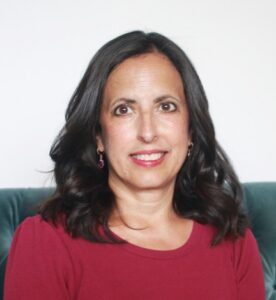
Dr. Rana Awdish is the bestselling author of In Shock, a landmark medical memoir. She is the Medical Director of Care Experience at Henry Ford Health and a pulmonary physician. She was Schwartz Center’s National Compassionate Caregiver of the Year and a U.S. News & World Report Healthcare Hero. She is recognized as a leading voice on healing, has written for The New England Journal of Medicine, JAMA, Harvard Business Review, and The Washington Post. She has been featured on NPR, BBC, and CNN.