It’s the weekly executive huddle and, as usual, the Chief Financial Officer is droning on, sucking the air and the life from the room. Your colleagues’ shoulders droop with the fatigue of it all, but the CFO controls the budget so everyone puts up with it.
We’ve all been there – concealing our exasperation while our colleagues repeat the same irritating behaviors meeting after meeting, month after month: They interrupt, they fiddle with their phones, they name drop, they humblebrag, they hedge. How can they miss the annoyance you leak with every encounter? And if they do notice it, could they change behaviors that seem deeply ingrained?
As an expert in fraud detection, I spent much of my professional career training executives, investigators, and law enforcement how to spot the tells that reveal deception or misconduct. That work became my first book, Liespotting . Over time, I realized my clients wanted more: They didn’t just want to spot the lie. They wanted insight into the secret, often unspoken currents that shape power, trust, decision-making, alliances and influence in their organizations. They wanted to understand why clients, customers, colleagues and bosses behave the way they do, and they wanted to send the right signals themselves.
For the next decade, I researched and studied the science of social observation across multiple fields – psychology, anthropology, intelligence gathering, and even comedy – to understand how people can hone their ability to read complex human environments in real time. How does a comedian win back a room when a joke bombs? What does it mean if your boss twirls her pen just as you present your big idea?
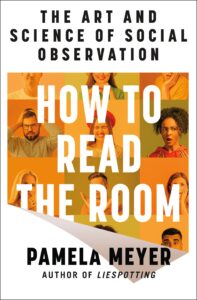
This work culminated in How to Read the Room: The Art and Science of Social Observation. People, whether alone or in groups, generate a steady stream of signals that can tell you so much more about their emotional state, their engagement with an idea, their relationships with one another, and their potential for conflict if you know how to spot the signals.
Reading the room begins with knowing who is in it. Whether you’re at a party or in a board meeting, reading the room depends on getting beyond the names, titles, the resume or their spot on the org chart to ferret out their character and personality – and perhaps even understand what drives their annoying habits.
How to Build a Profile of Someone: The Triple B Method
We generate mountains of public online data: Facebook posts, LinkedIn profiles, Instagram feeds, presentation videos, PowerPoints, and business listings. Yet cutting through all that data to create an accurate picture is difficult business. I developed “The Triple B” method for getting a quick read on someone’s personality focused on three key areas: background, behavior, and beliefs.
A caveat: A personality profile is a starting point that offers enough insight into someone’s inner life to help you build trust and connection quickly. It will never be a substitute for the knowledge you gain when you’ve known someone for years. It is not a fixed point or a verdict. It is your first working hypothesis, which gets checked and revised based on what you observe when you’re reading the room.
Background begins at the surface level to give you the what, when and where of someone’s life, such as age, family structure, education, job history, where they lived, and the political, civic and professional circles in which they move. Fraternity member? Which one? Military service? Active combat? Where?
The next layer of background, formative experiences, is where the ‘why’ lives. The early events that shape identity and worldview often explain why people behave as they do. For example, a person raised in a single-parent household may develop independence and self-reliance, but they also may be reluctant to depend on anyone or, conversely, attach strongly to a group that accepts them. A person raised in a boom-or-bust household may be risk-averse or cautious because they see good times as fleeting. A person who witnessed social injustice may stand up for others while also reacting strongly to instances at work of nepotism, favoritism or unequal treatment.
The second pillar of Triple B, behavior, is a test of social observation. Rather than an interview, which is often performative, observing how someone behaves in low-stakes, everyday moments offers more insight. Notice specific habits, such as emails that arrive in the middle of the night, interruption patterns, gossip tendencies or whether their desk is tidy or in danger of avalanche. How do they handle criticism? We call this behavioral “residue” because its easy to spot if you bother to look—and its enormously informative. Ask if someone is a blame shifter, a “yes” person, a manic phone-checker, or an obsessive weather checker.
The final pillar, beliefs, are the deep convictions. Different from opinions, which may shift as situations and facts change, beliefs remain stable over decades and can predict how someone will act in a high stakes moment or when no one is watching. In a corporate setting, someone who values order may embrace defined job titles, hierarchy, and chain of command while someone who values autonomy may balk at rigid rules and inflexible structures. People often claim values they do not live. When their actions contradict those claims, you learn which beliefs truly govern their behavior.
Our Deepest Needs
Decades of research on human motivation suggests that basic psychological needs shape how we behave and interpret the world.. Self-Determination Theory defines these invisible internal drivers as autonomy, the desire to be masters of our own destiny; competence, the need to feel capable and effective; and relatedness, the yearning for connection and belonging. When we can’t fill our basic psychological needs, we chase validation, react defensively, overlook the truth.
Here are some ways in which unmet core psychological needs get misdirected in the flow of everyday life.
Lack of a sense of Autonomy leads to:
Passive resistance
Desire for independence
Defensiveness when choices are limited
Lack of a sense of Competence leads to:
Overcommitment to gain recognition
Avoidance of challenging task
Excessive preparation or work hours
Lack of a sense of Relatedness leads to:
Constant need for approval
People-pleasing and conflict avoidance
Anxiety when others are distant
And that brings us back to the long-winded CFO. The Triple B method turns irritation into a working hypothesis. Their behavior suggests a need to dominate, while their belief in hierarchy may make that dominance feel justified. An unmet need for competence may explain the drive to keep proving their expertise.
Read background, behavior, and beliefs together, and you enter the room with a far better idea of what is driving the people in it.
Interested in more? How to Read the Room is available now!

Pamela Meyer is the author of the forthcoming book How to Read the Room. A leading expert on deception detection, she trains executives and institutional leaders in information elicitation, social observation, and insider threat mitigation from her Washington, D.C. firm.