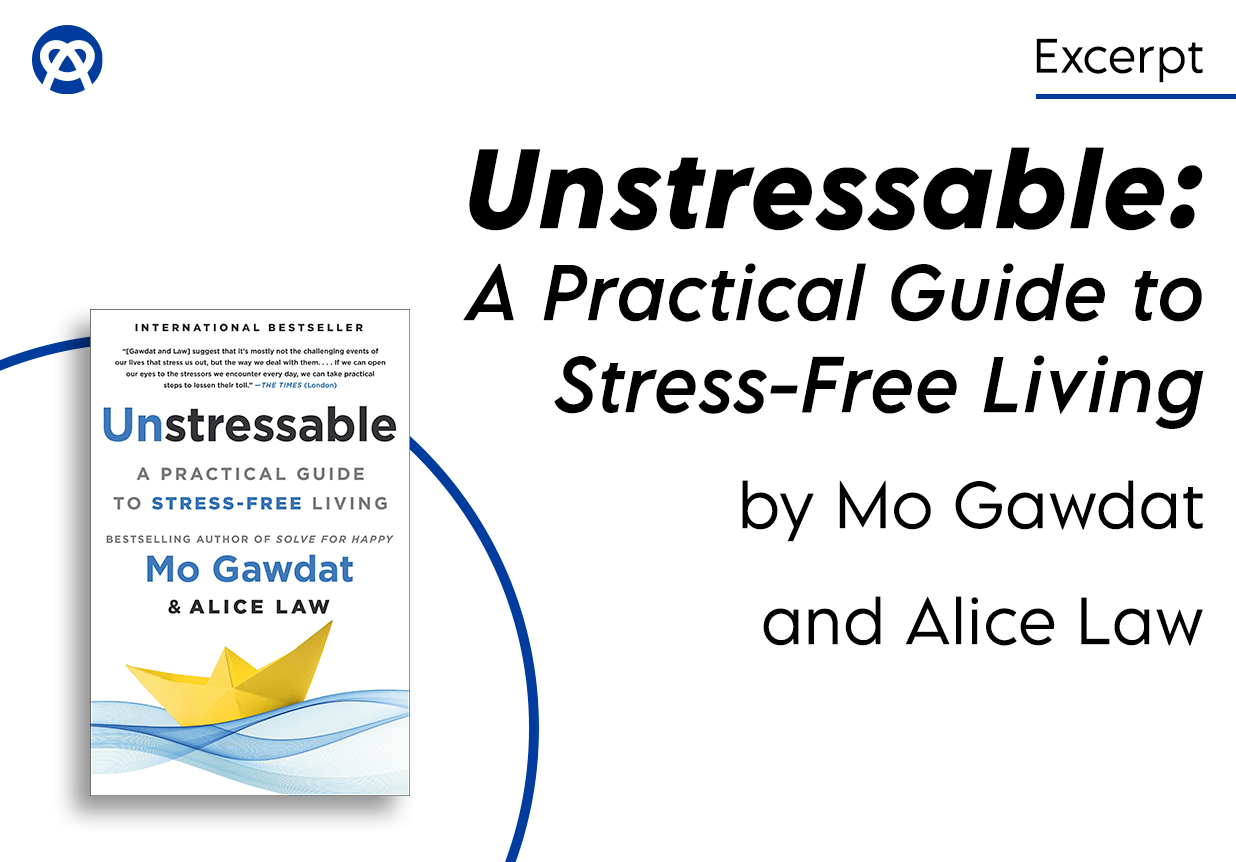
What if you could stop stress before you feel it? Mo Gawdat is an engineer. What most of us see as insurmountable problems he sees as systems overloads to tackle and solve. Unstressable breaks stress into inputs and effects, classifying human stressors as: stress to the mind, stress to emotions, stress to the body, and stress to the soul. Once classified, Gawdat and co-author Alice Law show readers how stress can be predicted—and once predicted, prevented. Read (or listen) an excerpt about how to use this handbook for understanding that stress isn’t what happens to you; it’s how you handle what happens to you.
Have you ever imagined an easy-flowing and stress-free life? Can you remember a time when you lived that way? When things were not too complicated? There were not too many commitments to clutter your day, and when things became a little challenging, you rose to the occasion and handled them with ease? Is it even possible to live predominantly stress-free?
Well, this book claims that it is—that it is easy to achieve and that it is your absolute duty to make that a reality. Stress, as a cycle, is not difficult to understand, and when you get how it works, it’s not difficult to avoid and suspend. A bit of stress is needed to keep us safe and help us reach peak performance, but to be stressed all the time is not how things are supposed to be.
Our machines seem to be broken. We need to get them into the workshop and fix them. But before we do, like any good engineer would, we need to grasp the very details of how the machines work in the first place.
BIOLOGY, CHEMISTRY, AND NEUROSCIENCE
Feeling stressed is the product of a very complex process that happens across the nervous and endocrine systems of your body. Complex but highly predictable, as in it happens exactly the same way every single time you or I have ever felt stressed. That feeling we’ve become accustomed to in the modern world requires a highly synchronized interaction between biology, chemistry, and neuroscience for you to feel it. Several parts of your brain and nervous system work in tandem with your glands to get you there. Like with the turbocharger on a sports car engine, when mixing the fuel with oxygen in different ratios, a normal engine turns into a beast of a machine. Similarly, when you’re stressed, you’re a totally reconfigured machine, different from your normal self.
There’s been a bit of a debate across the scientific establishment for years around where stress originates. While the traditional view seems to imply that thoughts in your rational brain trigger your stress, lots of recent research points to the opposite—that your stress is triggered first, and then the emotions and physical sensations resulting from stress prompt your rational brain to think. Those thoughts would then help you calm down or boost you to become more stressed. I guess both scenarios apply depending on what stresses you. Let me explain.
FEELING STRESSED
Stress is an automatic response. Your stress starts with a trigger. An event that seems like a possible threat takes place.
The event stressing you is not even recognized by your thinking brain. For example, when that friend you never really liked sneaks up behind you and shouts, “Boo!” As he stands there laughing, you jump out of your skin, your heart beating fast, and you feel a version of the stress that you would feel if you were up against a saber-toothed tiger. In a fraction of a second, you feel the stress first, and then you think about it later. What engages instantly, in those cases, is one side of your autonomic nervous system (which, as the name implies, is responsible for automatic functionalities of your body, such as keeping your heart beating without you thinking about it). The side of this system that engages is normally referred to as the sympathetic nervous system, which is activated upon recognizing threatening events that demand a fight, flight, or freeze response.
Copyright © 2025 by Mo Gawdat and Alice Law

Mo Gawdat is the former Chief Business Officer at Google X, bestselling author of Solve for Happy, and host of the podcast Slo Mo. For more than a decade he has researched happiness and conversed with thousands of people in more than a hundred countries. He lives in Dubai.

Alice Law is a Stress Management Consultant, Speaker and host of the podcast Unstressable with Alice Law. She has worked internationally with a multitude of private clients and large organisations, to help them to both manage and prevent stress, so that they can reach their greatest potential.
Together they co-founded Unstressable LLC, which aims to take 1 million people a year out of stress, through their online membership platform, corporate speaking engagements and book.