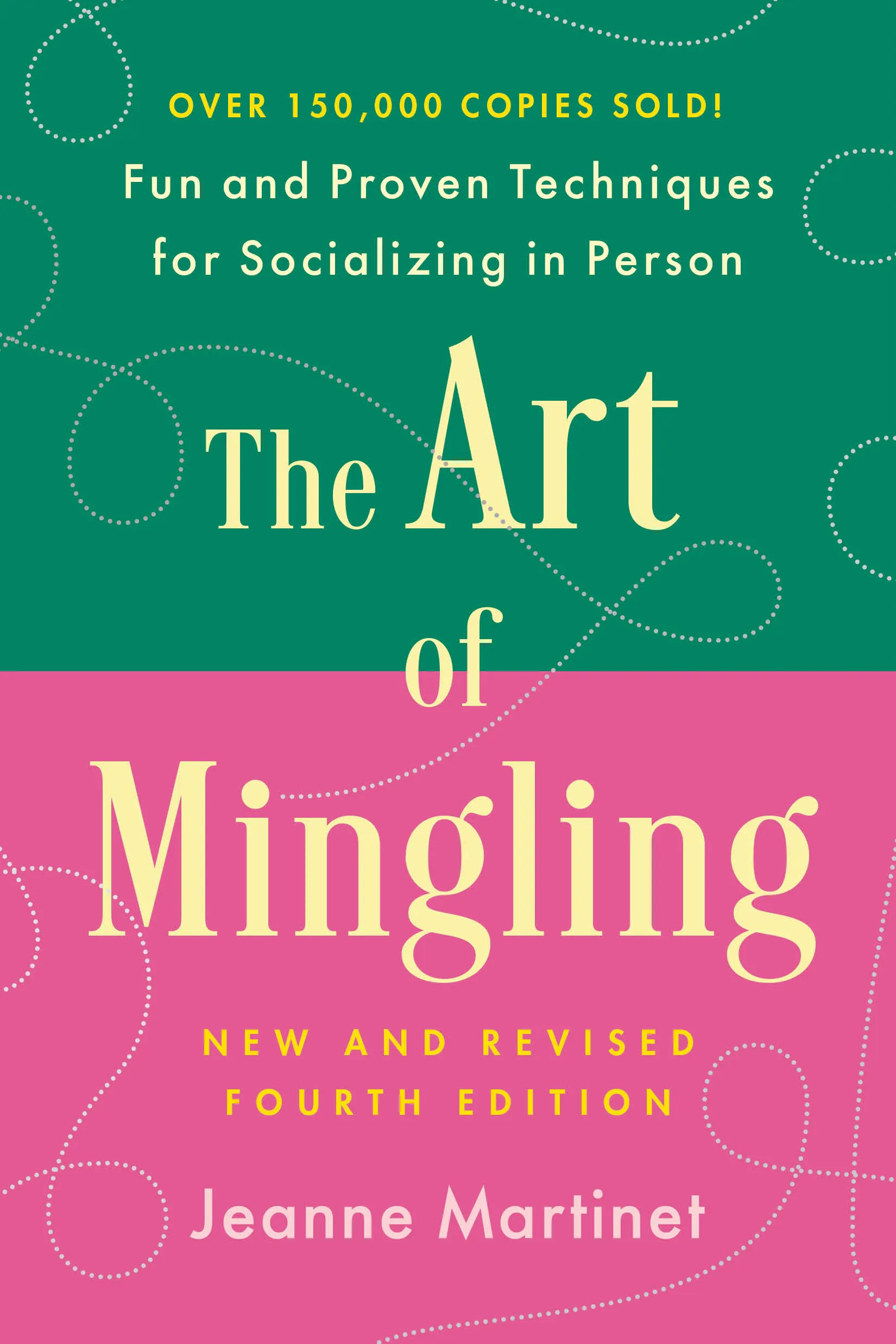
Does the idea of going to a party make your mouth go dry? Are you more comfortable on FaceTime than you are face-to-face? Do you find yourself living a screen-only life? You’re not alone; ninety percent of the world suffers from minglephobia, and Jeanne Martinet has the cure. The Art of Mingling, Fourth Edition encourages you to get off your apps, get back out there and make real-life connections. Fully revised with 40% new material, the author has completely updated her sure-fire system for overcoming social fears and having a great time at any type of business or social get-together. Read an excerpt from The Art of Mingling, Fourth Edition below.
Why Learn the Art of Mingling?
You are at a party. The guests are attractive, the food is fabulous, the décor is divine—nothing could be more wonderful, right?
Wrong. It’s a nightmare. You want desperately to disappear. Everywhere around you are people who seem to know each other. They are talking and laughing, having a great time, while you are standing all alone, wishing with all your heart and soul that you were somewhere else—anywhere else—but here. Two firm convictions keep you from dying on the spot: (1) You are definitely going to take the life of the friend who somehow convinced you that you needed to expand your horizons by coming to this party. And (2) if this night ever ends, you will never ever leave the safety of your home again.
An exaggeration? Maybe. But I know plenty of people, of all ages and from all walks of life, who are perfectly comfortable with one-on-one or small-group social interactions but confess to a secret terror of medium to large parties of any kind. The very idea of having to talk to a lot of people they don’t know makes them go dry in the mouth. They’ll do anything to avoid mingling situations. Many opt out, telling themselves they are skipping the party because they have too much work to do or that they are too tired to go—even that they have nothing to wear. Others, the self-professed intro-verts of the world, tell themselves parties are just “not their thing.” This kind of avoidance is a shame bordering on a tragedy, because larger affairs, whether they be business or “social” functions, are potentially more exciting and energizing than small get-togethers. They are fertile arenas for meeting new and interesting people (I met a woman at a fundraiser twenty-five years ago who became one of my best friends). And yet, simply because of apprehension, aversion, or lethargy, people often waste these opportunities either by not going to the gathering, or by going with a colleague or companion and never leaving their side. Anything, they think, is better than to risk being left standing all alone looking pathetic. And even that is preferable to suffering the incomparable, utter agony of being face to face with someone you’ve never talked to before and not knowing what to say.
People who feel this way (and there are more of them out there than you might imagine) have a widespread disease known as minglephobia. Is there a cure? Yes. Because contrary to what you might think, “making small talk,” “being a social butterfly,” or “working the room” is a learned art—a simple one—that anyone can master.
It’s true that social skills seem to come more easily to some than others, and there are a lucky few who are actually born mingling geniuses (in fact, I once saw a small child work a room so well it was scary). But most people have to practice. With practice, even the pathologically shy, as well as the more common tongue-tied or foot-in-mouth types, can learn simple tricks, lines, and maneuvers that can mean the difference between misery and enjoyment—between a night of feeling out of place and a night of feeling happily engaged.
“Tricks? Lines?” some of you will undoubtedly protest. “But that sounds so insincere, so artificial.” My response: There is a big difference between “artifice” and “art.” If a dancer simply got up and did what came naturally, would that be as powerful and effective as when they perform practiced moves? Through-out this book I will suggest many small pretenses, but I will never encourage anyone to be untrue to themselves in any real sense. You must think of mingling as a kind of enjoyable and challenging game, like a tennis match or pickleball. It’s never a bad thing to learn a new skill. And after all, we are talking about mingling here, not marriage. It’s about having fun.
Of course, there are more than a few misguided, non-minglephobic souls who think mingling takes too much energy or is simply a ridiculous waste of time, that it is nothing but an endless stream of meaningless conversations with people you will never see again. And yes, I admit I’ve had my share of inane discussions about weather or traffic. But I’ve also had countless ten-minute conversations about supposedly trivial subjects like wallpaper that were fascinating, after which I’ve usually gone home feeling buoyed and more connected to the world. You must never forget that simply being in a room full of people who are communicating with one another is exhilarating! Just look up “mingle” in the dictionary: “to become mixed, blended, or united; to associate or mix in company.” Sounds stimulating, even sexy, doesn’t it? It is. I know from experience.
The fact is, small talk has been given a bad rap. Small talk is a little like the antipasto or the appetizer of a conversation. It may not be a main entrée, but sometimes you can have an entire wonderful and satisfying meal consisting only of appetizers. Many of the strongest relationship bonds that occur between people are created by just riffing playfully and spontaneously in conversation. Sometimes small talk can be a lot better at connecting you to others than “big talk,” and after all, connection is the name of the game. An increasing amount of research shows that small talk (especially with strangers) is good for us.
I’ll tell you a secret. Although I have always adored parties—anywhere, anytime—mingling didn’t come naturally to me at all. But when I was about thirteen, I made up my mind that I would become a mingling virtuoso. I proceeded to teach my-self the art over the course of years, by trial and error. I have collected tips and adapted techniques from countless friends and acquaintances, as well as by consulting other experts. All the methods I use have been tested and honed for best results, and now I have a system that never fails. It’s easy, and you can learn it, too.
Each of the following techniques and lines is applicable to just about any type of gathering. However, there’s one fundamental principle to remember as you begin to study this time-honored art: Your purpose in any mingling situation is to have fun. This is an absolutely vital, hard-and-fast rule; your success as a mingler depends on this basic premise. Whether you are at a business affair or a neighbor’s party, whether you are mingling for love or for career advancement, your primary goal must be your own enjoyment. You may see a given mingling situation as a means to climbing the proverbial corporate ladder or hooking up with a hottie, but unless you are truly enjoying meeting and talking with people, your success will be limited. The truth is that mingling is its own reward.
All of us have a deep desire to talk to other humans. Conversation is one of life’s greatest pleasures. The more people you meet and connect with, the more potential you have for happiness. Mingling can actually feed your spirit; in other words, the more you mingle, the better your life will be. The warm, communal feeling you will experience when you leave a party after meeting and enjoying new people will spread to the rest of your life and enrich it. And trust me, if you become less socially fearful, you will be less fearful in other areas of your life—in your business life, in your relationships. The art of mingling may not be the answer to everything, but it is an important part of living a full and rewarding life.
So take a deep breath, and let’s mingle!
Copyright © 2026 by Jeanne Martinet

Jeanne Martinet is the author of nine books, including The Art of Mingling which has sold more than 150,000 copies and been published in ten countries. She has been featured in such publications as The New York Times, Newsweek, Cosmopolitan, Glamour, and The Washington Post. She has shared her humor and mingling know-how on hundreds of podcasts, TV and radio shows, including “The Today Show,” “The CBS Early Show,” and NPR’s “Morning Edition.” She has been a keynote speaker and has given workshops on the subjects of mingling and networking. Born and raised in Baltimore, she lives, writes and mingles in Manhattan.