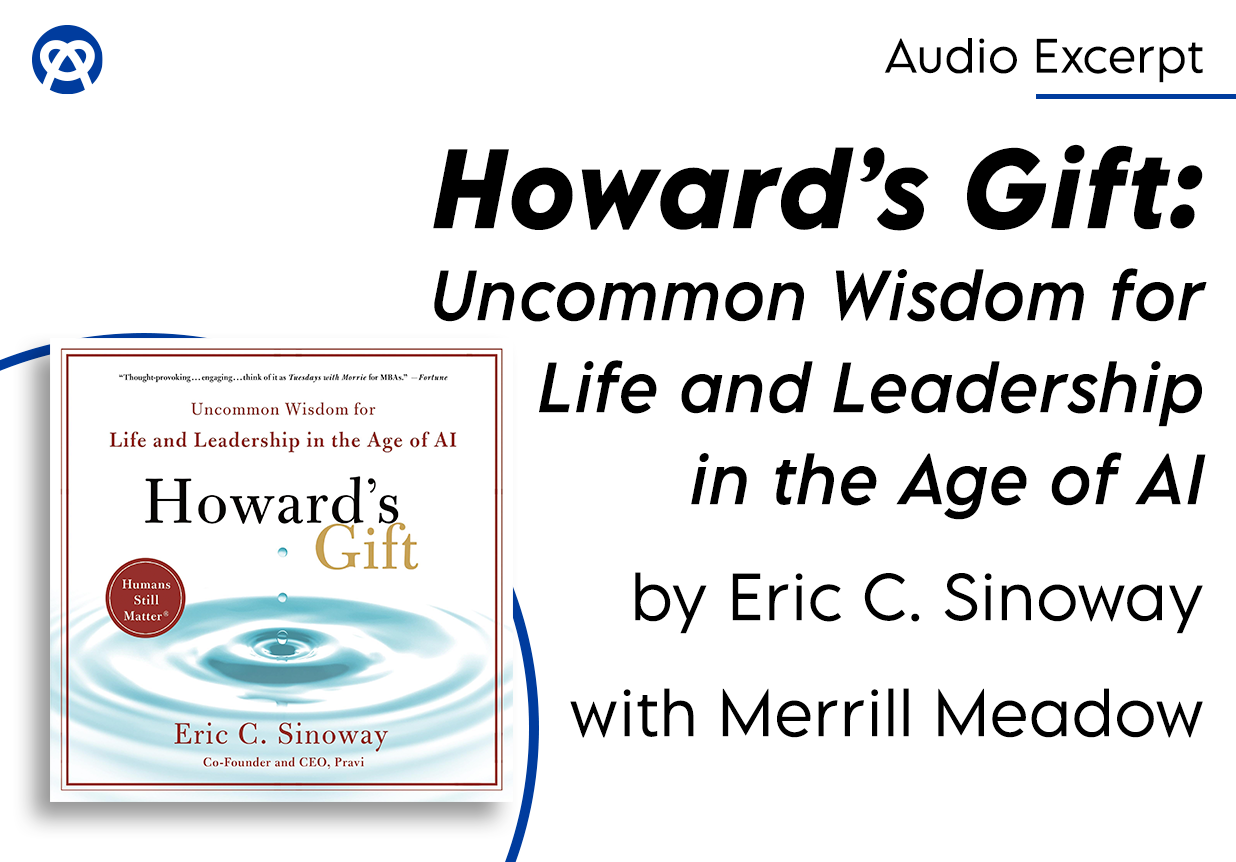
During a forty-year career, Howard H. Stevenson taught at Harvard Business School, chaired NPR, and co-founded a hedge fund, The Baupost Group. His definition of entrepreneurship inspired leaders and institutions around the world. In this revised edition of Howard’s Gift, Pravi CEO Eric Sinoway, Howard, and contributors share practical wisdom for life and leadership in the age of AI.
Listen to an audio excerpt Howard’s Gift. This program features an AI-assisted authorized replica voice based on the voices of Howard H. Stevenson and Eric C. Sinoway.
You can also read the excerpt below.
Business Planning for Your Life’s Work
We can all use a wise man or woman in our lives. Someone who helps us make sense of the challenges we face. Who guides us as we navigate times of change. Who counsels us as we move along life’s path.
Who among us wouldn’t want to call on a person with wisdom and experience when we have to make important decisions about our careers and our personal lives? Especially when those decisions are fraught with risk and uncertainty, and complicated by fundamental changes in the world around us.
And let’s face it, wisdom is at a premium, as we’ve experienced an unbelievable amount of change over the last few years.
When I first had the idea of writing this book, the stock market was at an all-time high, prosperity was increasing all over the world, and megamillionaires were being created every other day. It looked like the economic good times would never end. Quite frankly, it was an environment in which many people who weren’t getting rich—and that’s most of us—were wondering why not, and whether we should be approaching our lives and careers in a very different way.
The assumption, of course, was that wealth equaled success and success equaled happiness. The initial concept for this book was to help people think through how to achieve happiness and meaning in their lives within that environment.
And then things changed, seemingly overnight.
In a breathtakingly short period of time, the economic world as we knew it imploded. A company that was once synonymous with American economic success, General Motors, went bankrupt.
The disintegration of a single Wall Street icon, Lehman Brothers, threatened the entire global finance system. Average people—like you and me and the folks across the street—unwittingly helped overzealous lenders drive the nation’s mortgage industry and housing market over a cliff.
As a society, we ran headfirst into an inflection point.
What is an inflection point? It is what Andy Grove, the founder and former CEO of Intel, defined as an event that fundamentally changes the way we think and act. Usually, an inflection point isn’t a little change. It is a moment when—by choice or not—we pivot from the path down which we are traveling and head in an entirely different direction.
During the past dozen years, we’ve gone through several extraordinary inflection points. We have experienced a series of economic and political events that caused the future to look very different from what we’d expected it would.
Until not too long ago, a whole generation of college graduates believed they were destined to follow the path of the founders of Microsoft, Google, and Facebook and become multimillionaires before they were thirty. Investment banking was seen as the guaranteed path to becoming a “master of the universe.” People were celebrated as heroes for running companies based on business models that, in any other time, would have been considered laughable. Policy makers in Washington, DC, were so confident that the stock market would keep rising—seemingly forever—that they considered privatizing Social Security, the economic safety net of the American working man and woman.
Beginning in 2007 and continuing to this day, we’ve been reminded of two rules that we’d apparently forgotten: (1) what goes up does eventually come down, and (2) businesses built on a foundation of smoke and mirrors will surely fail.
At breakneck speed, discussions about the stock market turned to preserving capital, not growing it. People with jobs were satisfied just to keep them—forget about promotions and raises. Homeowners went from visions of windfall profits to hopes of avoiding foreclosure. Folks with newly minted college and graduate degrees suddenly faced a frozen job market.
Even those people whose financial lives did not collapse had a tremendous scare. And we’re all trying to guess if there’s a new problem just over the horizon.
In times of extraordinary challenges and dizzying change—whether it’s happening around us or to us—we can all use a wise guide. A person who helps us think through our basic assumptions about what we want and need in our lives, about what “success” means to us and how best to navigate our lives during unsettling times.
Wise men and women come in plenty of flavors and sizes, and with varying degrees of insight. Like beauty, wisdom is often in the eye of the beholder. And the wisdom you find depends a lot on the kind of wisdom you may benefit from at a particular moment. For some, the ideal wise person looks like Abraham Lincoln or Mother Teresa; for others it’s Warren Buffett or Oprah Winfrey.
The wise man I’ve found is a mixture: he has the business acumen of Warren Buffett, and the warmth and spirit of Morrie Schwartz, Mitch Albom’s professor in the book Tuesdays with Morrie. He also has a rather humorous resemblance to Yoda, the wise, skilled, and experienced Jedi knight of Star Wars fame.
Although my wise man looks a bit like Yoda, in place of a light saber he wields razor-sharp logic and scalpel-like insight. He is a real-life teacher, mentor, and guide through challenging, risky, and downright scary adventures. His name is Howard Stevenson.
Howard is an entrepreneur, an author, and a philanthropist. And for forty years, he has been one of the most important and respected professors at Harvard Business School. He possesses an amazing combination of business brilliance, keen psychological perception, energetic spirit, and long-term vision. He has an endearing perspective on life, something I didn’t fully appreciate until it was almost gone.
Howard is exactly the kind of person that so many of us would like to be able to turn to when important decisions are to be made or challenges met. One whose wisdom and experience have guided thousands of men and women through the inflection points in their lives.
Over the course of four decades, Howard has taught, mentored, and counseled thousands of Harvard MBAs, graduate students, and global business leaders. His students have included world leaders, CEOs of major corporations, and entrepreneurs whose visions have changed our world.
Numbered among Howard’s many students, friends, and confidants are some of the most successful businesspeople and philanthropists in the world. They have included people like Jorge Paolo Lemann, the Brazilian billionaire co-owner of the international beverage conglomerate Anheuser-Busch InBev, William Bowes, one of the creators of the U.S. bio tech industry; Hansjörg Wyss, the Swiss medical appliance industry pioneer and mega philanthropist; the late Frank Batten, who created the Weather Channel; and Arthur Rock, the legendary investor who helped launch Intel and Apple.
Why have business icons like Lemann, Bowes, Wyss, Batten, and Rock—people who have reached the pinnacle of professional success—continued to look to this remarkable man? For the same reason that I do: to benefit from the insight, wisdom, warmth, and pragmatic perspective that this rumpled Harvard Business School professor shares with everyone whose life he has touched.
This book is my way of introducing you to my friend and mentor Howard Stevenson.
Copyright © 2012 by Eric Sinoway. Preface copyright © 2026 by Eric Sinoway. Foreword copyright © 2026 by Howard H. Stevenson. All rights reserved.

Eric C. Sinoway is the CEO of Pravi, a best-selling author, and a keynote speaker. He is the architect behind two tools to navigate the intersection of humanity and AI: the Humans Still Matter® Operating Lens and the Decision Wisdom framework. Sinoway’s thought leadership has been featured by CNN, Fortune, and Harvard Business Review, where his article No, You Can’t Have It All has been published worldwide. He is the author of Howard’s Gift – Uncommon Wisdom for Life & Leadership in the Age of AI inspired by his long collaboration with Harvard Business School professor Howard Stevenson.