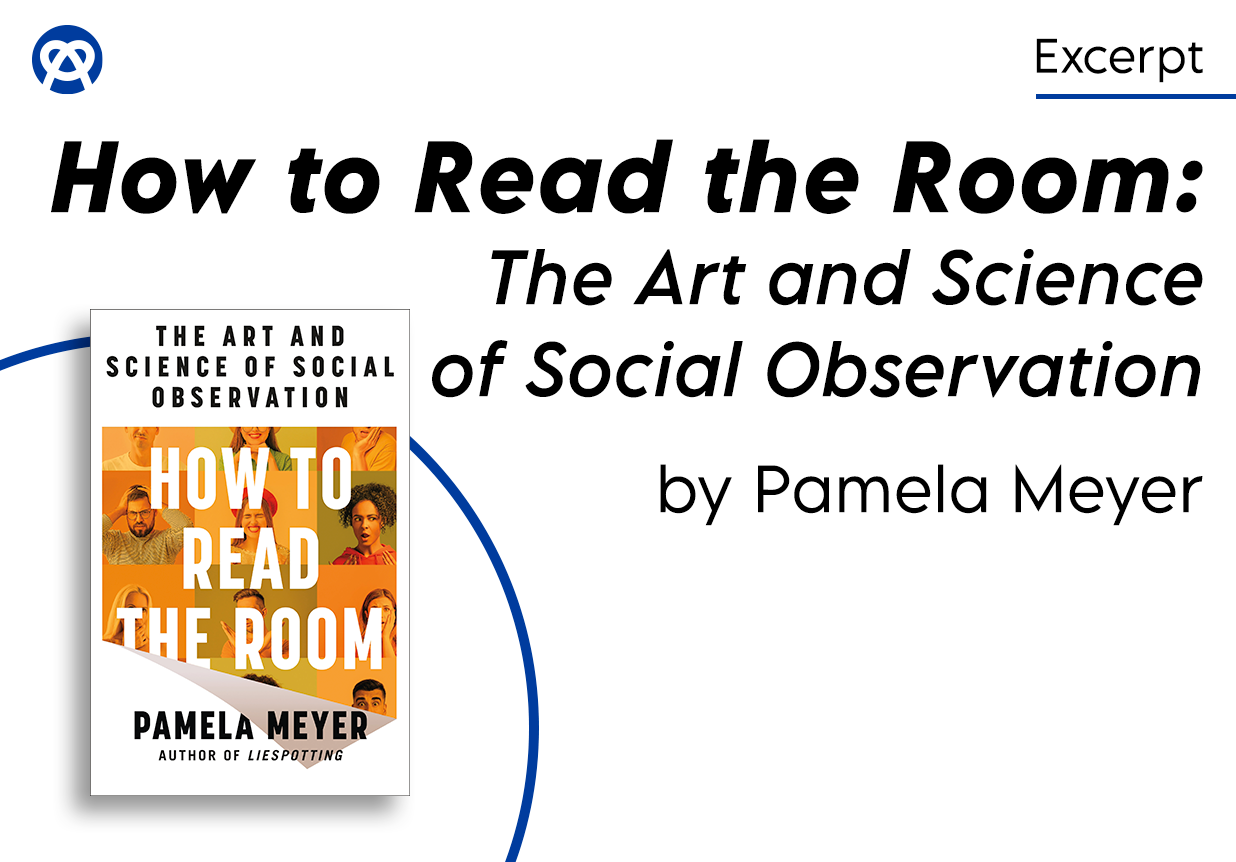
In all aspects of today’s world, power, trust, and influence are negotiated in every glance, pause, and click. Perfecting the art of social observation is the key to success in any endeavor. In How to Read the Room, Pamela Meyer draws on cutting-edge behavioral science, intelligence-agency tradecraft, and real-world storytelling—from comedy clubs and boardrooms to digital deepfakes and family dinners—to reveal the unseen forces that shape every human encounter. This essential survival manual introduces a clear, four-step framework for social observation—one that turns the elusive art of “reading people” into a disciplined practice. Read an excerpt from How to Read the Room below.
THE PAYOFF OF READING THE ROOM
Room readers share certain traits. They rarely raise their voices, because precision replaces force. They adjust the temperature of an encounter rather than demanding that it change. Their authority comes from what they see, not what they say. And they’re less anxious because the confidence that comes with clarity quiets the mind. When you know every room is legible if you listen long enough, you stop entering situations braced for threat. You enter curious.
This awareness doesn’t stay contained. Couples who observe tone and posture during conflict repair faster. Parents who notice micro-signs of stress intervene before outbursts. Organizations that cultivate observation build trust that withstands crisis.
When people ask me what separates the successful from the merely competent, I tell them about Daniel and Maya. And then I tell them what you gain when you learn to read the room:
You waste less time. You know within five minutes if a pitch is landing or dying. You stop explaining when people have already decided. You end meetings that should’ve been emails.
You gain trust faster. People feel safe around someone who actually sees them. Trust grows when you notice what others miss and address it with competence and kindness.
You build deeper relationships. Real connection happens when someone feels understood. When you sense what people need before they ask. When you know to call on Tuesday because Monday was rough. When you remember what matters and show up for it.
You repair things before they break. You’ll catch the slight in your partner’s voice before it becomes a fight. You’ll sense when your kid needs space versus when they need you to push. You’ll notice when a friendship is drifting and do something while there’s still something to save. Most relationships die from a thousand tiny moments nobody noticed.
You get what you want more often. You’ll know when to speak and when to get out of the way. When to lead and when to let someone else be the hero.
You make fewer enemies. You’ll catch tension before it escalates into conflict. You’ll sense the bruised ego before it hardens into a vendetta. You’ll identify land mines and step around them instead.
You actually enjoy rooms more. Once you stop performing and start observing, conversations become fascinating. Every meeting is invisible chess. Every dinner party is a master class in human behavior.
The room is always talking. Most people never learn to listen. They rarely have “Master Social Observer” as part of their identity. They don’t realize this is a skill you can cultivate, or a muscle you can build. They think some people are just “naturally intuitive” and leave it at that.
But you’re reading this book, which means you’ve already started paying attention differently. What follows in these chapters is the framework: how to prepare before entering a room, how to sense its undercurrents, how to interpret the language of motion and silence, and how to act with timing and influence that earns cooperation rather than compliance.
Master these skills and you don’t just read rooms better.
You become someone people want in the room.
PART ONE
PREPARE TO READ THE ROOM
Getting social perception right starts long before you show up. You can’t barrel into a room full of investors or sit down for a first Thanksgiving dinner with your in-laws and expect to get by on charm. That might happen, but your odds of connecting deeply with people improve exponentially if you take the time to prepare beforehand. People who seem naturally at ease in rooms actually did their homework. And you can too.
First: Discover your own blind spots. You distrust people who went to Ivy League schools. You defer to older men because of something to do with your father. Someone laughs like that kid in middle school, and you’ve already labeled them a bully. As you’ll see in chapter 1, your blind spots distort your view of the room significantly. Identifying them is the hardest work of all.
Second: Perform reconnaissance. Intelligence professionals gather information before they go into the field. You should too. Chapter 2 covers my systematic method for researching people in the room before you enter it. This advance work improves your odds of connecting with people.
Third: Free your brain before you walk in. Chapter 3 is about freeing up attention so you can watch the room instead of managing your own anxiety. When you reduce cognitive load, you get a much more accurate read. And you have more fun too.
Copyright © 2026 by Pamela Meyer

Pamela Meyer is a Certified Fraud Examiner and the founder and CEO of Calibrate, which trains businesses in fraud detection, threat mitigation, and security. Previously, she worked as a media executive for over 20 years. She is the author of Liespotting and her work has appeared in Business Week, The Atlantic, Harvard Business Review, The Wall Street Journal, and CNN, among others. Meyer holds an MBA from Harvard University and a master’s degree in Public Policy from Claremont Graduate University.